

Showing all 3 results
Hand signals cover the standard vocabulary of recreational diving, but there are situations where precise information needs to pass between divers and no signal exists for it — a specific depth, a compass bearing, a note about a marine species, or a direction to a photography subject. Writing slates solve this problem with no batteries, no signal dependency, and no failure modes beyond losing the pencil. The range here covers three formats: a hand-held underwater slate and two wrist-mounted versions, one of which includes pre-printed reference information.
Slates as Practical Dive Tools
A writing slate is a rigid or semi-rigid panel made from white polypropylene or a similar smooth-surface plastic that accepts pencil marks and can be wiped clean with a thumb or cloth. The material is inert in both fresh and saltwater, does not absorb moisture, and does not degrade under UV exposure at the rates that affect softer polymers. Pencil — not pen — is the correct writing instrument: graphite leaves a clear mark on a slate surface at any depth and temperature, while ink-based pens depend on pressurisation mechanisms that become unreliable at depth and in cold water.
Slates are used across several diver types. Instructors use them to correct student technique without surfacing. Underwater photographers and videographers use them to direct models or communicate shot requirements. Technical divers use them to record gas readings, ceiling depths, and decompression information when a dive computer is not available or as a backup. Navigation divers use them to sketch site maps or record compass headings at key decision points.
Hand-Held vs. Wrist-Mounted Formats
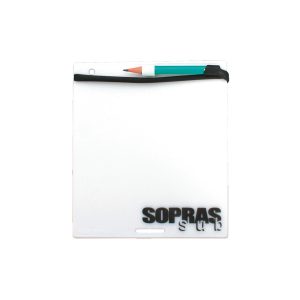
The Underwater slate is a standard hand-held format — a flat panel that the diver holds in one hand while writing with the other, then clips to a D-ring or stores in a BCD pocket when not in use. This format provides the largest writing surface of the three options and is well-suited to instructors or divers who frequently exchange detailed written information. The trade-off is that retrieving and deploying it requires one hand to be free.
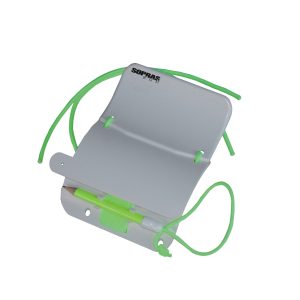
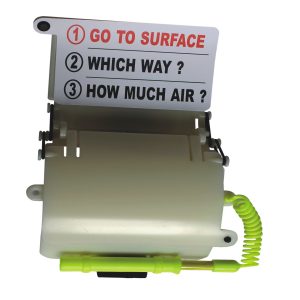
The Underwater wrist slate and the Writing wrist slate with instructions both mount on the forearm using a strap, keeping the writing surface accessible without requiring the diver to unclip anything. Both hands remain free for buoyancy control and equipment management; the slate is simply there when needed. The Writing wrist slate with instructions adds pre-printed reference content to the slate surface — typically decompression or dive table information — which eliminates the need to carry a separate reference card on dives that involve gas management or planned decompression stops. This is the most information-dense option and the one most relevant to divers progressing toward technical training.
What to Look For
- Surface texture and pencil compatibility. A writing slate must accept a standard graphite pencil without requiring significant pressure — heavy pressure while writing underwater is impractical and tiring. The surface should produce a clear, readable mark in the light conditions typical of the dives you do. Darker environments may require higher contrast marks, which depends as much on pencil hardness as on the slate surface itself. A medium-grade pencil (HB or B) is generally adequate.
- Wrist strap fit over a wetsuit. Wrist slates are worn over a wetsuit sleeve, not against bare skin. The strap must accommodate the thickness of the sleeve — a 5 mm or 7 mm wetsuit adds considerable circumference to the forearm compared to a 3 mm suit or a skin suit. Check strap adjustment range before purchasing if you dive in varying thermal protection depending on the destination.
- Pre-printed content relevance on the instruction slate. The Writing wrist slate with instructions is only useful if the pre-printed reference information matches the dive tables or decompression model you actually use. Confirm the printed content before purchasing if you are using a specific decompression algorithm.
- Attachment method for hand-held slates. The Underwater slate should have a lanyard hole or clip point so it can be secured to a D-ring when not in active use. A slate that floats away during a moment of inattention is a practical and potentially hazardous loss in an overhead environment.
- Erasability. All three slates erase with a thumb or cloth wipe. There is no meaningful difference between them on this parameter, but it is worth confirming before first use that the pencil supplied or used does not leave permanent marks — some wax-based pencils do not erase cleanly from polypropylene.
Maintenance and Care
Writing slates require minimal maintenance. Rinse in fresh water after each salt dive and allow to dry fully before storage. Pencil marks erase completely with a damp cloth or simply with thumb pressure. Do not use abrasive cleaners or scouring pads on the writing surface — scratches in the polypropylene retain pencil residue and progressively reduce legibility. Store slates flat or in a position where the surface cannot be scratched by metal equipment. Replace the attached pencil when it becomes too short to hold securely with gloves — a half-worn pencil is difficult to control at depth. If the wrist strap on a wrist slate begins to harden or crack from repeated UV and saltwater exposure, replace it before it fails during a dive.
FAQ
Why can’t I use a ballpoint pen on a writing slate?
Ballpoint pens use a pressurised ink system that relies on a specific operating pressure range to feed ink to the ball. Underwater pressure and cold water temperature both affect this mechanism, commonly causing skipping, failure to write, or ink leakage into the water. Graphite pencils have no moving parts or pressure-sensitive mechanisms and function identically at the surface and at 40 m depth. Pencils are the standard writing instrument for all diving slates without exception.
Is a wrist slate or a hand-held slate better for recreational diving?
For most recreational divers, a wrist slate is more practical because it is always accessible without unclipping anything. The Underwater wrist slate mounts on the forearm and can be written on with the hand of the same arm used as a stable surface, or held with one hand while writing with the other. The hand-held Underwater slate offers a larger writing area and is easier to share with a buddy — it can be passed between divers — but requires deliberate deployment and a free hand. Divers who frequently give directions to others, such as instructors or guides, may prefer the hand-held format for its larger surface.
What information is pre-printed on the Writing wrist slate with instructions?
The Writing wrist slate with instructions includes pre-printed dive reference data alongside the erasable writing area. This typically covers dive table reference information or decompression stop guidance. Divers using this slate as a backup to a dive computer should verify that the printed reference data matches the decompression model used by their computer or training agency before relying on it for gas management decisions.
Can writing slates be used in full darkness or low visibility?
In very low visibility or full darkness, a slate can still be written on if the diver has a light source — torch or primary dive light — illuminating the surface. The white polypropylene background provides good contrast with graphite pencil marks under a focused beam. In absolute darkness without a light source, a slate is not useful. For night diving where communication is important, position the writing surface under the torch beam and use large, simple marks rather than detailed notes.
Do I need a writing slate if I already have a dive computer?
A dive computer handles gas and decompression management, but it does not replace a slate for communication, navigation notes, or recording information that the computer does not capture. Underwater photography coordination, species identification notes, compass headings, and buddy communication all remain functions of a slate. Technical divers frequently carry both — a computer as the primary instrument and a wrist slate as a backup for manual decompression calculation if the computer fails.
“`
—
### 3. Meta title
“`
Underwater Writing Slates – Wrist & Hand-Held
“`
—
### 4. Meta description
“`
Underwater slate, wrist slate and wrist slate with dive instructions. Polypropylene, pencil-ready, saltwater-proof. Order now.