

Showing all 2 results
A BCD bladder is the inflatable chamber that provides buoyancy lift — the functional core of any buoyancy compensator. This category carries the Tekno Donut series of toroidal wing bladders, designed for use in modular backplate-and-wing configurations for recreational and technical diving. For a broader selection of bladder models, additional options are available at SoprasTek.
For more bladders you can visit SoprasTek website.
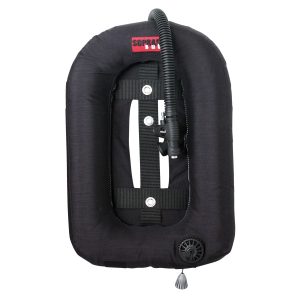
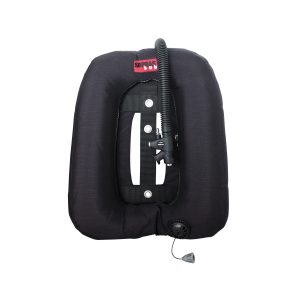
Toroidal Wing Bladders: How the Donut Geometry Works
A toroidal bladder (commonly called a donut) inflates as a closed ring around the backplate and cylinder attachment point rather than as an open horseshoe or a flat back-inflate sack. This geometry has two practical consequences. First, lift is distributed symmetrically — as gas enters the bladder it expands equally to both sides, keeping the diver’s trim balanced rather than creating a stronger lift on one side as a partially inflated open-cell wing can. Second, the ring structure prevents the bladder from collapsing inward at low inflation volumes, which is a problem with horseshoe wings where the open ends of the bladder can fold over each other and block gas flow to the dump valves.
The Tekno Donut 14 l and Tekno Donut 16 l differ in their maximum lift capacity. The 14-liter bladder provides lift sufficient for single cylinder configurations — including steel 15-liter cylinders at depth — with some reserve capacity. The 16-liter bladder is intended for diving configurations that require additional lift: heavier steel cylinders, drysuit diving in thick undergarments, or setups with significant negative ballast such as stainless steel backplates. Both bladders mount to the same backplate mounting geometry and are compatible with the Plastic back plate systems in the Harnesses subcategory.
Bladder Construction and Materials
BCD bladder durability depends primarily on the inner bladder material (typically urethane-coated nylon or TPU film) and the quality of seam construction. The Tekno Donut series uses a welded seam construction rather than sewn seams — welded seams eliminate the needle holes that stitching creates in the bladder material, which are potential leak points under repeated pressure cycling. The outer fabric layer is coated nylon, providing abrasion resistance against the backplate hardware and tank band contact points that a bare bladder would experience in normal use.
The inflator connection port on both donut models uses a standard direct system inflator (DSI) interface, accepting the same inflator hose used on jacket BCDs. The overpressure valve is positioned on the bladder perimeter at the lowest point of the ring — when the diver is horizontal, this corresponds to the rear-most point of the donut, which is where gas collects during ascent and needs to be vented. The valve opens automatically when internal pressure exceeds ambient pressure by approximately 1.5–2 bar, preventing bladder rupture during rapid ascent.
What to Look For
- Lift capacity matched to total negative buoyancy. Add the negative buoyancy of your cylinder at depth (a full 12-liter steel cylinder is approximately −3 kg in salt water; an empty aluminum 12-liter is approximately +1 kg), your ballast weight, and any negative contribution from your exposure suit at depth. Your bladder’s rated lift must exceed this with at least 2–3 kg of margin for surface inflation reserve.
- Backplate compatibility and mounting bolt pattern. Toroidal bladders mount via a central bolt that passes through the backplate. Verify that the donut’s central hole diameter and bolt specification matches your backplate before purchase — different manufacturers use different bolt standards.
- OPV position and venting orientation. On a donut bladder, the OPV should be positioned so it is at or near the highest point of the bladder when you are in your normal horizontal swimming position. If the valve is at the bottom of the ring when you’re horizontal, gas will pool in the upper arc of the donut and cannot be vented automatically — requiring manual inversion to vent, which is impractical during normal diving.
- Bladder volume distribution. A 14-liter and 16-liter donut are the same physical diameter but the 16-liter has a larger cross-sectional tube diameter. This affects how the fully inflated bladder sits behind the diver — a larger-diameter tube projects further from the backplate, which can create buoyancy behind the center of gravity if the diver’s tank is short. Check that the inflated bladder profile fits within your expected trim without pushing your legs down.
- Oral inflate valve quality. The oral inflate mouthpiece must create an airtight seal under both positive and negative pressure — a leaking oral valve can allow water ingress into the bladder during a dive, or allow gas to escape when you’re trying to inflate. Test the valve before each dive season by orally inflating the bladder fully and checking that no gas escapes with the mouthpiece released.
Maintenance and Care
After every salt water dive, flush the bladder interior with fresh water: partially inflate the donut, introduce fresh water through the oral inflate valve, slosh it thoroughly around the ring, then drain by inverting the bladder and opening the OPV. The toroidal shape requires more effort to flush completely than a flat wing — ensure the water reaches the full circumference of the ring, not just the lower arc near the drain point. Repeat at least twice per diving trip.
Inspect the OPV seat and spring annually. The OPV on a donut bladder is under identical stress to the valve on a jacket BCD, but is more critical because a toroidal wing that won’t vent automatically during ascent is a serious hazard — the diver cannot easily invert in the same way as with an open-wing configuration. A valve that sticks open will drain the bladder continuously; a valve that sticks closed will not vent during an ascent. Replacement OPVs are available in the Spare Parts for Jackets subcategory.
Store the donut partially inflated (enough to maintain the ring shape without collapsing) in a cool, dry location. The toroidal shape is self-supporting at partial inflation; fully deflating and folding the donut creates creases in the urethane bladder lining at the fold points, which can develop micro-cracks over repeated folding cycles. Hang the bladder or lay it flat rather than folding if full deflation is necessary for transport.
FAQ
What is the advantage of a donut bladder over a horseshoe wing?
A horseshoe wing has two open ends that can collapse onto each other at low inflation volumes, blocking gas flow and creating asymmetric lift. A donut’s closed ring prevents this — at any inflation volume above essentially zero, gas is distributed symmetrically around the ring. For technical diving, this means more predictable buoyancy response during deco stops and more consistent trim at low inflation volumes when you’re making fine depth adjustments. For recreational use with a single tank, a horseshoe wing performs adequately, but the donut geometry is the more reliable design at the extremes of the inflation range.
Can I use the Tekno Donut with a jacket BCD?
No — the Tekno Donut is a standalone wing bladder designed to mount on a backplate. It has no outer shell or integrated harness and cannot be retrofitted into a jacket BCD housing. The donut is only appropriate for modular BP/W configurations where the bladder mounts independently behind a separate backplate-and-harness system.
How do I choose between the 14 l and 16 l donut?
If you’re diving a single steel 12-liter cylinder with a wetsuit, the 14-liter donut provides sufficient lift with margin. If you’re using a steel 15-liter cylinder, a drysuit with heavy undergarment, a stainless steel backplate, or a double cylinder configuration, the 16-liter donut ensures you have enough reserve lift to surface and support yourself positively even with a flooded drysuit or lost weights. When uncertain, a larger bladder does not cause problems — it simply inflates less than its maximum capacity in use.
Can the bladder be repaired if it develops a small leak?
Small pinhole leaks in the outer fabric can be patched using a urethane-compatible patch kit. Leaks at the OPV mount or inflator port typically require valve replacement rather than patching, as these are molded interfaces under cyclic load that don’t hold fabric patches reliably. Seam leaks on welded-seam bladders are more difficult to repair — a separated weld line usually indicates the bladder has reached the end of its service life and should be replaced rather than patched.
How long does a bladder typically last?
With proper maintenance — regular fresh water flushing, proper storage, and annual valve inspection — a quality bladder can last 5–10 years of regular use. The most common failure modes are OPV spring fatigue (addressed by annual valve replacement), UV degradation of the outer fabric (prevented by proper storage away from sunlight), and oral inflate valve seal wear (detectable during pre-dive inspection). Bladders that are stored deflated and folded, exposed to UV, or that have salt water left inside between diving seasons typically fail much sooner.