

A diving knife is a safety tool, not a weapon — its primary function is to cut entangling material: monofilament fishing line, net, rope, kelp, and guideline that a diver may become caught in underwater. The range covers two size categories: compact cutters and knives up to 11 cm blade length for everyday recreational use and technical diving where minimal bulk is a priority, and larger knives and scissors above 11 cm for working divers, wreck exploration, and applications where a more substantial cutting tool is required. Blade materials include stainless steel, titanium, and black-coated steel; mounting options include leg straps, BCD-mount pouches, and neoprene holsters.
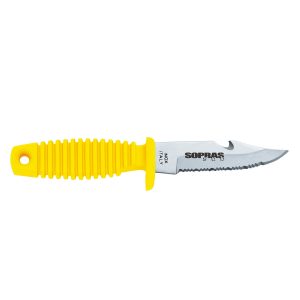
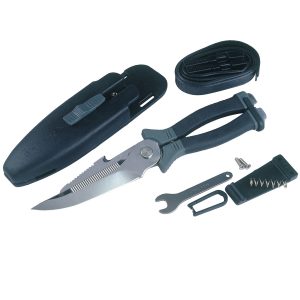
Blade Materials: Stainless Steel vs. Titanium
The two blade materials in this range are stainless steel and titanium. Stainless steel diving knives use a high-chromium alloy, typically 420 or 440 series, which provides good corrosion resistance in both fresh and salt water when properly maintained. Stainless blades are harder than titanium and take a sharper edge more easily; they are the most cost-effective option for the majority of recreational and sport divers. Some stainless models in the range use a black teflon or black oxide coating on the blade — this reduces surface corrosion, minimises light reflection underwater, and provides a degree of additional protection against minor blade surface abrasion, though the edge itself remains uncoated.
Titanium knives are lighter than stainless equivalents of the same size, genuinely corrosion-proof (titanium does not rust in salt water under any conditions), and maintain their surface finish without coatings. The trade-off is a slightly lower hardness rating, which means titanium blades require more careful sharpening with appropriate tools. For divers who leave equipment rigged and stored wet between dives — live-aboards, frequent day-trip divers — titanium eliminates rust entirely. The foldable knife variants in both stainless and titanium provide a compact, closed-blade option for carrying off the dive site without a sheath.
Blade Geometry: Point, Blunt Tip, and Serrated Edge
Diving knife blades combine two cutting requirements: a straight-edge section for general cutting and controlled slicing, and a serrated section along the spine or lower portion of the blade for sawing through rope, kelp stems, and thick net cord. The serrated section cuts materials that would deflect a straight edge under lateral pressure. Most knives in this range include both a straight and a serrated portion on the same blade. Blade tip geometry varies: a pointed tip allows prying and directed stabbing cuts; a blunt or rounded tip (including the Titanium without point model) eliminates the risk of accidental puncture to equipment, suits, or buoyancy cells and is the preferred configuration for many technical and cave divers where the knife contacts the diver’s own equipment during retrieval from a tight sheath.
Cutters and small knives (up to 11cm)
Compact cutting tools up to 11 cm blade length: line cutters, foldable knives in stainless and titanium, small fixed-blade knives, and mounting accessories including knife straps and neoprene holsters. Minimal hydrodynamic profile for recreational and technical use.
Larger knives and scissors
Full-size diving knives above 11 cm blade length in stainless steel, titanium, and coated blade variants. Models include pointed-tip, blunt-tip, and serrated configurations for working divers, wreck exploration, and demanding cutting tasks.
Mounting Options
Where the knife is mounted affects both access speed and hydrodynamic profile. The primary mounting positions are the lower leg (inside or outside of the calf), the BCD shoulder or chest strap, and the forearm. Leg mounting using an adjustable rubber or nylon knife strap is traditional and positions the blade accessibly for the diver’s own hand; the strap fits around the calf and holds the sheath securely against the leg. The neoprene knife holster is an alternative sheath-and-mount combination that attaches to the BCD strap or calf and provides a softer, low-profile mount with secure retention. BCD-integrated knife pockets (available on some BCD models) mount the knife on the chest, which is practical for backmount technical diving where leg-mounted gear creates drag. For cave diving and other environments where a knife must be reached with either hand, a forearm mount or BCD chest position is preferred. Foldable knives can be carried clipped to a D-ring without any dedicated sheath.
What to Look For
- Blade length appropriate for your primary use. For recreational diving where the knife is an emergency-only tool, a compact cutter or knife up to 11 cm provides all necessary cutting capability without adding meaningful bulk. Larger knives are warranted for working divers, shore diving in areas with heavy kelp or net debris, and wreck penetration where rope or guideline management is part of the dive plan.
- Stainless for cost and sharpness; titanium for zero corrosion maintenance. Stainless blades require rinsing and periodic drying to prevent surface rust; titanium requires no corrosion maintenance at all. If the knife will be left rigged wet between dive days, titanium is worth the additional cost. For divers who rinse and dry equipment after each use, stainless is entirely adequate.
- Pointed vs. blunt tip for your environment. A pointed tip is useful for penetrating and prying; a blunt tip is safer around inflatable equipment, dry suits, and lift bags. Technical and cave divers frequently prefer blunt-tip knives to eliminate the possibility of accidental puncture during self-rescue procedures in tight spaces.
- Sheath retention and one-handed draw. In an entanglement emergency, the diver must be able to draw the knife one-handed from the sheath while potentially disoriented. Test the sheath retention mechanism before diving — the knife should be retained securely against inadvertent loss but releasable cleanly with a single hand motion without requiring visual confirmation of the release mechanism.
- Line cutter as minimum baseline. If carrying a full knife is not preferred or permitted, a dedicated line cutter (recessed hook-blade design) provides the essential entanglement-cutting function in an extremely compact, snag-free format. All divers should carry at minimum a line cutter on every open water dive.
Maintenance and Care
Rinse knives in fresh water after every salt water dive. Remove the blade from the sheath during rinsing — salt crystallises inside the sheath and accelerates corrosion at the blade surface if left wet inside the sheath. Dry the blade fully before storage, ideally with a light application of mineral oil or silicone spray on the stainless blade surface to displace moisture. Sharpen stainless blades with a ceramic or diamond sharpening rod; titanium blades require a diamond sharpening tool specifically. Inspect the sheath retention mechanism at the start of each season — rubber retention clips and spring-loaded retainers fatigue over time and must be replaced before failure causes the knife to be lost on a dive. The knife strap rubber should be inspected for cracking and replaced when it no longer retains tension; a strap that slips allows the knife to swing freely or fall off the leg during the dive. For foldable knives, apply a drop of water-resistant light oil to the pivot joint periodically to prevent the joint from corroding stiff.
FAQ
Is a diving knife mandatory equipment?
Diving knives or cutters are strongly recommended by all major training agencies as standard safety equipment, though they are not legally mandatory in most recreational diving environments. Specific environments — kelp forests, areas with active commercial fishing gear, drift diving routes with mooring line exposure — present a materially higher entanglement risk where a cutting tool moves from recommended to effectively essential. Most technical diving training agencies treat a cutting tool as mandatory equipment for any penetration or overhead environment dive. At minimum, every open water diver should carry a line cutter — the smallest and most compact cutting tool available — on every dive.
What is a line cutter and how does it differ from a knife?
A line cutter uses a recessed hook-blade design: a small curved blade set inside a protective housing with a slot opening. The line or monofilament is passed into the slot and drawn across the blade — the recessed design means the blade cannot accidentally cut the diver’s suit or gloves during retrieval and does not require a sheath. Line cutters are extremely compact and can be carried clipped directly to BCD webbing or a D-ring without any additional mount. They are designed specifically for cutting thin line, monofilament, and light rope rather than heavy net cord or kelp stem; for those materials, a serrated knife blade is more effective. Many divers carry both a line cutter as a primary backup on every dive and a full knife for more demanding conditions.
What does the black blade coating (teflon/black oxide) do?
Black blade coatings serve two purposes: they reduce light reflection from the blade surface underwater (relevant for underwater photographers and videographers who do not want blade glare in the frame, and for dive guides who do not want to startle marine life), and they provide a modest additional layer of surface corrosion protection beyond the base stainless steel alloy. The coating does not replace stainless steel’s inherent corrosion resistance — it supplements it. The blade edge itself is sharpened through the coating during manufacture and during re-sharpening; only the flat of the blade carries the coating. Teflon-coated blades are slightly more slippery through soft materials (kelp, rope) than bare stainless.
Where is the best position to mount a diving knife?
The optimal mount position is wherever the diver can reliably reach the knife with either hand while submerged, restricted, and potentially disoriented. For most recreational divers, the inside of the lower left calf using a leg strap is conventional — it is accessible to the right hand and out of the main equipment configuration. For technical and cave divers, the BCD shoulder or chest strap allows access with either hand and removes the knife from the leg where it could snag on a guideline. Try reaching for the knife’s draw position on dry land while wearing full gloves before committing to a mount location; if you cannot draw cleanly with either hand, reposition the mount.