

Showing 1–12 of 14 results
This section covers compact cutting tools with a blade or cutting element up to 11 cm in length: dedicated line cutters with a recessed hook-blade, small fixed-blade knives, foldable knives in stainless steel and titanium, and mounting accessories including knife straps and a neoprene holster. These tools are sized for minimum hydrodynamic profile and everyday carry on all dives — their compact format makes them compatible with BCD-mount, leg-strap, and clipped-to-webbing carry methods without adding meaningful drag or bulk to the diver’s configuration.
Products in This Category
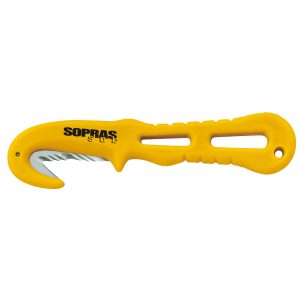
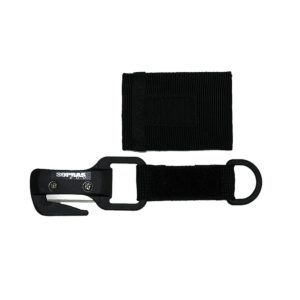
The 14 items in this category fall into four types. Line cutters — the Line cutter (SKU 57150/K,Y in black or yellow) and Line cutter with pouch (SKU 571520) — use a recessed hook-blade that cuts monofilament and light line without exposing a conventional blade edge. The version with pouch includes a small BCD-attachable carrying case. These are the simplest and most compact cutting tools available and are appropriate as a minimum safety item for all recreational divers.
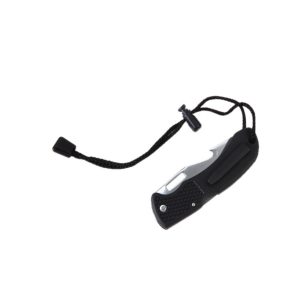
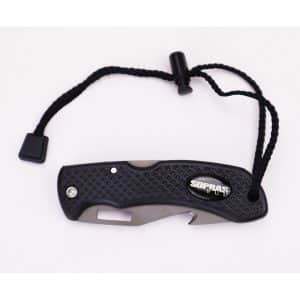
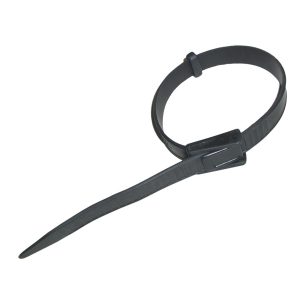
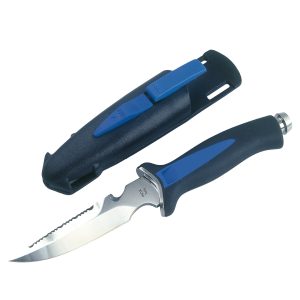
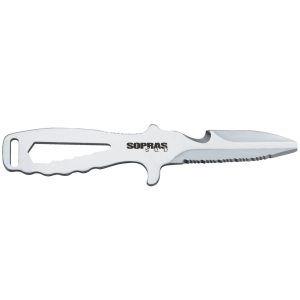
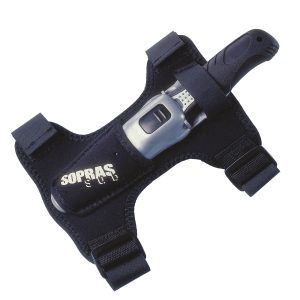
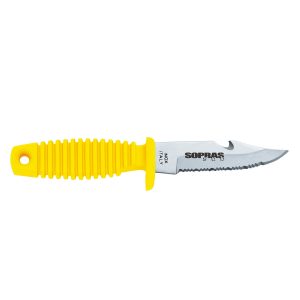
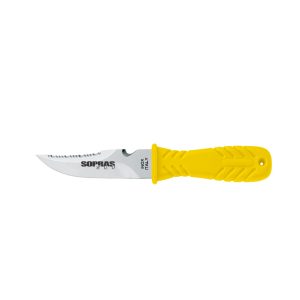
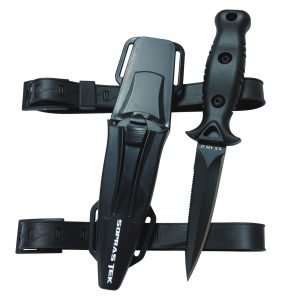
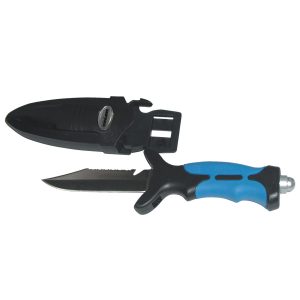
Small fixed-blade knives include the Shark 9 (9 cm blade, black or yellow handle), Squalo 11 (11 cm blade, black or yellow), Sub 9 (9 cm), Sub 11 (11 cm), Metalsub (stainless, compact format), SS Dive knife (stainless, black-coated blade), Strong (stainless, black or green handle), and Master knife (the most capable model in this size group at 64€). All fixed-blade models include a sheath for leg-strap or BCD-strap mounting. Foldable knives — the Foldable knife SS (stainless, 25€) and Foldable knife titanium (53€) — fold to a palm-size closed format that can be clipped to a D-ring without a sheath. Mounting accessories — Knife strap (rubber leg strap, 6€) and Neoprene knife holster (22€) — are sold separately and are compatible with all fixed-blade models in this range.
Choosing a Compact Cutter or Small Knife
The primary decision in this size category is between a dedicated line cutter and a small fixed-blade knife. A line cutter is the minimum effective tool for monofilament and thin fishing line entanglement — the most common hazard in recreational coastal and offshore diving. It requires no sheath, clips directly to webbing, and is operable with thick gloves because the recessed blade is guided by the housing. A small fixed-blade knife adds serrated and straight-edge cutting capability for thicker rope, kelp, and net, at the cost of slightly greater bulk and the need for a sheath and mounting hardware. For most recreational divers, carrying a line cutter as a primary tool and a small fixed-blade knife as a backup provides complete coverage of realistic cutting scenarios.
Within the fixed-blade range, the Shark 9 and Sub 9 are the most compact options at 9 cm blade length — appropriate for divers who prioritise minimal profile above all else. The Squalo 11, Sub 11, Strong, and Master knife step up to 11 cm blade length, providing more leverage and cutting surface for heavier material while remaining within the compact category. The Master knife is the highest-specification model in this range — serrated and straight edge, robust handle with glove-friendly grip, and full sheath with strap hardware included. The SS Dive knife with black blade provides a coated-blade option at mid-price with a broad blade profile useful for prying as well as cutting.
What to Look For
- Line cutter as baseline for all divers. If only one cutting tool is carried, make it a line cutter. It is the lightest, most compact, safest-to-carry option, and it handles the most common recreational diving entanglement hazard — monofilament — more reliably than a conventional blade.
- Foldable knife for off-dive carry. Foldable knives can be carried clipped to a bag or belt when not diving without requiring a sheath. For divers who travel with equipment and prefer a single knife that works both in and out of the water, the foldable titanium model eliminates both corrosion and sheath bulk.
- Handle colour for visibility. Yellow-handle variants are more visible underwater and on deck — useful for locating a dropped knife in low visibility or quickly identifying the knife among other equipment on a boat. Black handles are less conspicuous and preferred by some technical divers who want minimal reflective surfaces.
- Neoprene holster vs. knife strap for BCD mounting. The knife strap is a simple rubber loop for leg mounting. The neoprene holster provides a more streamlined sheath that can be mounted on a BCD strap or shoulder, keeping the knife within the diver’s equipment profile rather than extending laterally from the calf.
Maintenance and Care
Remove fixed-blade knives from their sheaths after every salt water dive — salt crystals accumulate in the sheath interior and trap moisture against the blade, accelerating corrosion. Rinse blade and sheath separately, dry the blade fully, and apply a thin film of mineral oil or silicone spray before returning to the sheath for storage. For foldable knives, open the blade fully and rinse the pivot joint with fresh water; a drop of water-resistant light oil at the pivot after rinsing prevents the joint from corroding into a stiff or seized position. Inspect rubber knife straps at the start of each season — cracked or perished rubber loses grip tension and allows the knife to shift position or detach during the dive.
FAQ
What is the difference between the Line cutter and Line cutter with pouch?
Both are identical hook-blade line cutters. The version with pouch (SKU 571520) includes a small nylon or plastic mounting pouch that attaches to a BCD low-pressure hose, shoulder strap, or D-ring, keeping the cutter immediately accessible without clipping it directly to webbing where it might be awkward to retrieve. The pouch version is recommended for divers who want the cutter in a fixed, always-accessible position rather than loose on a clip. The cutter without pouch is more compact and can be carried clipped wherever most convenient for the individual diver’s configuration.
Can I use a foldable diving knife without a sheath?
Yes — foldable knives are designed specifically for sheath-free carry. In the closed position, the blade is fully protected inside the handle. The knife can be clipped to a D-ring, BCD webbing, or carried in a BCD pocket. To deploy, the diver opens the blade with one hand — verify that you can do this reliably while wearing your dive gloves before the dive, as the opening mechanism requires a fingernail or thumb notch which may be difficult to engage with thick neoprene gloves. Some divers use a small lanyard through the handle hole to allow pull-to-open deployment. Foldable knives should not be relied upon as a sole emergency cutting tool if the diver cannot confirm rapid one-handed deployment with their specific gloves.