

Showing all 11 results
This section covers full-size diving knives with blades above 11 cm: stainless steel, titanium, black-coated, and teflon-surface models in pointed-tip and blunt-tip configurations, from entry-level utility knives to high-specification professional tools. The range includes the Torpedo series, Sub 16 D, Squalo 15MR, Shark M, Shark universal, Divers universal knife, and titanium models with and without a tip. Mounting accessories — knife strap — are also included. These are the working tool of the two size categories, appropriate for diving environments with heavy entanglement risk, demanding cutting tasks, and applications where blade leverage and cutting surface matter.
Products in This Category
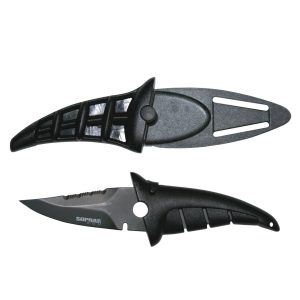
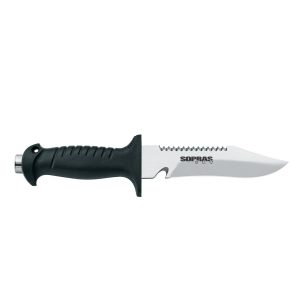
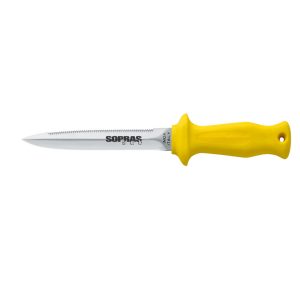
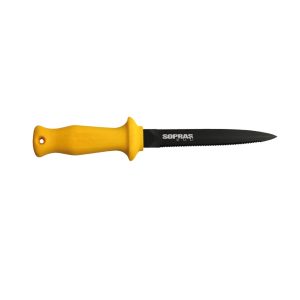
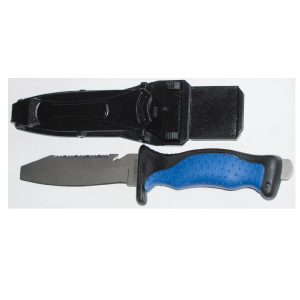
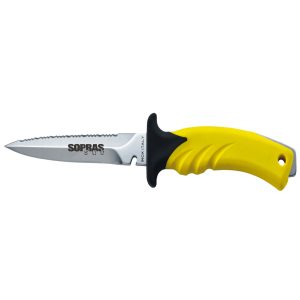
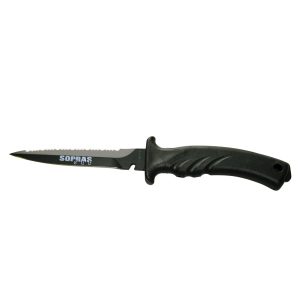
The 11 items span the full range from entry-level stainless steel utility knives to premium titanium professional tools. At the entry level, the Sub 16 D (SKU 57030, black or yellow, 28€) is a stainless steel knife with a 16 cm blade, combined straight and serrated edge, and a basic plastic sheath with integrated knife strap — the most accessible full-size knife in the range. The Sub 16 D with black blade (SKU 57031, 32€) is the same knife with a black teflon-coated blade for reduced reflection and enhanced corrosion resistance on the blade face.
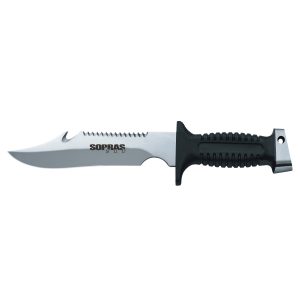
The Torpedo (SKU 571330, black or yellow, 50€) and Torpedo teflon (SKU 571331, 54€) are mid-range stainless knives with a broader blade profile, ergonomic handle designed for use with gloves, and a combined straight/serrated edge — the teflon variant carries the black coating. The Squalo 15MR (SKU 57020, black or yellow, 62€) is a 15 cm blade knife with a reinforced handle and combined edge. The Shark universal (SKU 571320/1, 58–63€) and Shark M (SKU 57010/1, 74–79€) are higher-specification stainless models with larger handles, more robust blade geometry, and available in two sub-variants (straight tip and alternative sheath configurations). The Divers universal knife new (SKU 571300, 115€) is the top-specification stainless model in the range — a comprehensive diving tool with full sheath and mounting system.
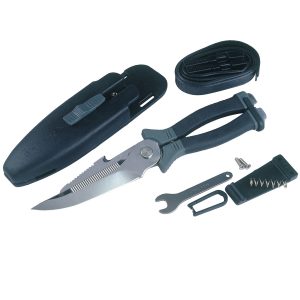
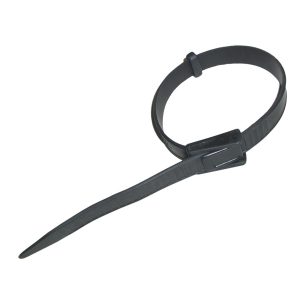
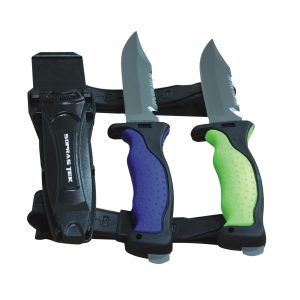
The Titanium knife (SKU 57183, blue or yellow, 95€) is a full-size titanium blade knife with the full corrosion immunity of the material and reduced weight versus steel equivalents of comparable size. The Titanium without point (SKU 571810, 90€) is the blunt-tip titanium variant — pointed tip removed and blade tip rounded — for technical and cave divers who require maximum safety around inflatable equipment and dry suits. The Knife strap (SKU 572100, 6€) is also listed here for mounting larger knife sheaths to the leg.
Blade Configuration Considerations for Larger Knives
At this blade size, the distinction between pointed and blunt-tip configurations is practically significant. A pointed blade is useful for penetrating material from above (cutting through a net section without slicing) and for prying mechanisms — the tip is used as a lever in some entanglement scenarios. A blunt tip eliminates the risk of accidental puncture during knife retrieval from a sheath in confined spaces, during buddy air-sharing where the diver’s BCD and equipment are in close contact with the knife, and in cave or wreck penetration where the knife contacts rock, concrete, or steel during movement. The Titanium without point is the only explicitly blunt-tip model in this range; other models carry a pointed tip. The teflon and black blade coatings reduce surface reflection and provide modest additional corrosion protection on the blade flat without affecting cutting performance at the edge.
What to Look For
- Blade length and weight appropriate for your diving style. Full-size knives above 15 cm add meaningful weight and bulk to the leg or BCD mount. For recreational and sport diving, a 15–16 cm blade covers all practical cutting requirements. Above this size, the additional blade length is relevant primarily for working divers dealing with thick rope, mooring lines, and heavy net material.
- Titanium for permanent wet storage or salt water residency. Divers on liveaboards, working in tropical environments, or who store equipment rigged between dives benefit most from titanium. The zero-maintenance corrosion characteristic of titanium is most valuable when the knife cannot be dried and oiled consistently.
- Blunt tip for overhead environments and technical diving. Cave and wreck penetration divers, dry suit divers, and technical divers with complex equipment configurations should consider the blunt-tip Titanium without point model — it eliminates puncture risk while providing full serrated and straight-edge cutting capability.
- Handle ergonomics with gloves. Test the grip of any full-size knife with the neoprene gloves you dive with before purchasing. At larger blade sizes, handle grip becomes more critical — a handle that feels secure with bare hands may be marginal with 5 mm gloves. The Shark M and Divers universal knife models have larger, more textured handles appropriate for gloved use.
Maintenance and Care
All maintenance guidance from the main Diving knives category applies in full. For larger stainless blades specifically: the greater surface area means more opportunity for salt water to remain trapped between blade and sheath — always remove the blade from the sheath before rinsing and dry both components separately. Full-size sheaths with leg strap hardware should have the strap hardware (buckles and D-rings) inspected for corrosion annually; stainless hardware resists rust but non-stainless elements on budget sheath assemblies can seize. Sharpen the straight-edge portion with a ceramic rod using consistent angle strokes; sharpen the serrated section with a tapered ceramic or diamond rod sized to fit the serration gullets. Do not use a flat sharpening stone on a serrated blade — it rounds the gullets and destroys the cutting geometry of the serration.
FAQ
What is the teflon surface on the Torpedo and Sub 16 D black blade models?
The teflon (PTFE) or black oxide coating is applied to the flat of the blade by a physical or chemical deposition process. It reduces surface friction — coated blades pass through soft materials (rope, kelp) with slightly less resistance than bare stainless. It also reduces the reflective glare of bare polished steel, which is useful underwater for photography and for avoiding startling marine life. The coating does not significantly affect corrosion resistance of the blade, which is primarily determined by the base stainless alloy; it does provide a modest additional barrier against minor surface oxidation between dives. The edge of the blade is ground through the coating during manufacture and remains uncoated — cutting performance at the edge is identical to an uncoated blade of the same steel specification.
How do I sharpen a serrated diving knife blade?
Serrated blades cannot be sharpened on a flat whetstone — the stone cannot reach into the curved gullets between serration points without rounding them. Use a round or tapered ceramic rod that fits the diameter of the individual serration gullets, and sharpen each gullet individually with two or three strokes at the original grind angle. The pointed tips of the serrations are sharpened incidentally by working the rod through each gullet. The flat edge section of the blade (non-serrated portion) is sharpened conventionally on a ceramic or fine-grit diamond rod. If the blade has not been sharpened in an extended period and the serrations have been mechanically damaged, the blade should be professionally sharpened or replaced — attempting to restore heavily damaged serrations at home risks further deteriorating the edge geometry.
What makes the Divers universal knife new the top model in this category?
The Divers universal knife (SKU 571300, 115€) is the highest-specification stainless model in the Soprassub knife range, combining a full-size blade with both straight and serrated edge sections, a robust ergonomic handle designed for wet gloved use, a full sheath with integrated mounting hardware, and a secondary tool element — typically a line cutter notch or bottle opener — integrated into the handle or spine. It is positioned as a comprehensive professional tool for working divers, dive guides, and instructors who use their knife regularly in demanding conditions rather than carrying it strictly as an emergency-only device. The higher price reflects the blade steel specification, handle construction quality, and the completeness of the included mounting system compared to mid-range models.