

Showing all 3 results
Neoprene adhesives for wetsuit repair — three products covering field repairs, workshop bonding, and flexible permanent repairs: the standard Glue for neoprene suits, the specialist GA Black Witch flexible contact cement, and the heavy-duty Eurofix for demanding repair applications.
Neoprene Adhesive Types and Applications
Neoprene requires a specific category of contact adhesive — standard household glues (epoxy, superglue, PVA) do not bond to neoprene correctly because neoprene’s closed-cell foam structure and flexible rubber chemistry require an adhesive that both bonds to the material and remains flexible after curing. Using a rigid adhesive on neoprene results in a bond that holds initially but fractures immediately when the neoprene flexes.
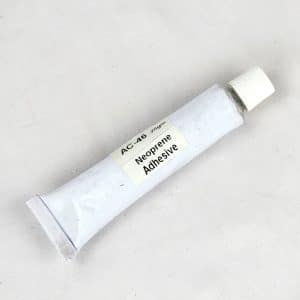
The Glue for neoprene suits (SKU 903000) is the standard contact cement for wetsuit repair — appropriate for bonding torn seams, reattaching delaminating seam tape, and repairing small tears. Applied to both surfaces, allowed to tack for 3–5 minutes, then pressed together firmly and allowed to cure. It is the most widely used neoprene adhesive and appropriate for the majority of wetsuit repairs encountered in recreational diving.
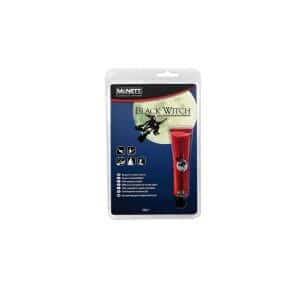
The GA Black Witch 28ml is a specialist flexible neoprene adhesive that maintains greater elasticity after curing than standard contact cement — particularly valuable for repairs at high-flex areas (knee panels, armpit, ankle seals) where the repair must stretch repeatedly without delaminating. Black Witch is a recognized brand in wetsuit repair with a track record in professional repair workshops. The 28 ml tube is sized for field repairs rather than workshop quantities.
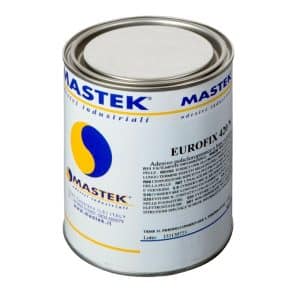
The Eurofix is a heavier-duty adhesive for demanding bonding applications — boot sole reattachment, repair of large delaminated seam sections, and structural bonding where maximum bond strength is required. It is thicker and more viscous than standard contact cement, which makes it more appropriate for gap-filling in irregular repair surfaces but requires more careful application to avoid excess adhesive squeeze-out.
What to Look For
- Match adhesive to repair type. Standard Glue for neoprene suits covers most repairs. Use Black Witch for high-flex areas or when previous standard-glue repairs at the same location have failed — this indicates the area is under more repeated flex stress than standard contact cement tolerates. Use Eurofix for structural repairs where bond strength is the priority over flexibility — boot sole reattachment is the primary application.
- Surface preparation is critical. All neoprene adhesives require a clean, dry surface for effective bonding. Remove salt, silicone lubricant, and any previous adhesive residue before applying. Sanding the neoprene lightly with fine sandpaper (180–220 grit) at the repair area increases the mechanical bond surface — particularly important for smooth-skin neoprene where the surface is already smooth. Clean with isopropyl alcohol and allow to dry completely before adhesive application.
- Curing time before use. Neoprene adhesive repairs require adequate curing time before being returned to water and subjected to flex stress. The minimum cure time for all three products is typically 2–4 hours for light handling; 12–24 hours before submersion and full flex load. Repairs done immediately before a dive trip and loaded immediately are the most common cause of repair failure.
- Tube shelf life after opening. Contact cement adhesives begin to thicken and lose effectiveness once the tube is opened and exposed to air. Partially used tubes should be sealed as tightly as possible immediately after each use. A tube that has been open for more than 3–6 months (depending on storage conditions) may have thickened to the point where it cannot be spread thinly enough for effective bonding — test on scrap neoprene before applying to a suit repair.
Maintenance and Care
Store neoprene adhesives at room temperature away from heat sources and direct sunlight — elevated temperatures accelerate the polymerization that causes the adhesive to thicken prematurely. Do not allow tubes to freeze — frozen contact cement separates and cannot be remixed effectively. Store tubes upright with the cap sealed tightly after each use. The Eurofix tube in particular should be squeezed from the bottom upward after each use and the cap cleaned of adhesive residue before sealing — dried adhesive in the cap thread prevents adequate sealing on subsequent uses.
FAQ
Can I use superglue to repair my wetsuit?
Superglue (cyanoacrylate) forms a rigid, brittle bond that fractures immediately when neoprene flexes. For a very small pinhole repair in a low-flex area, it may hold temporarily, but it is not appropriate for seam repairs, tears longer than a few millimeters, or any repair at a joint or seal area. Use proper neoprene contact cement — the three products here are the correct materials for wetsuit repair, and all are available at a cost that doesn’t warrant the risk of an improper repair to an expensive suit.
How do I repair a delaminating wetsuit seam?
Clean the delaminated area on both surfaces with isopropyl alcohol and allow to dry. Apply a thin, even coat of neoprene adhesive (standard Glue for neoprene suits or Black Witch for a high-flex seam) to both surfaces. Allow the adhesive to become tacky — typically 3–5 minutes at room temperature. Press the surfaces together firmly, starting at one end of the delamination and working toward the other to avoid trapping air. Apply firm, sustained pressure for 2–3 minutes across the full repair length. Allow to cure for a minimum of 4 hours before flexing. For seam delaminations longer than 10 cm, clamp the repair with spring clamps or wrap firmly with bandage material during curing to maintain pressure.
When should I use Black Witch instead of standard neoprene glue?
Use Black Witch when repairing areas that are subjected to repeated, significant flex during a dive — the knee panel, armpit, the wrist seal area of the arm cuff, or the ankle seal. These areas flex hundreds of times per dive, and a repair adhesive that remains highly flexible under repeated stress will outlast one that is adequate for static bonding but slightly more rigid. Also use Black Witch when a previous standard-glue repair at the same location has failed within one or two dive sessions — this indicates the area requires a more flexible bond than standard contact cement provides.