

Showing all 9 results
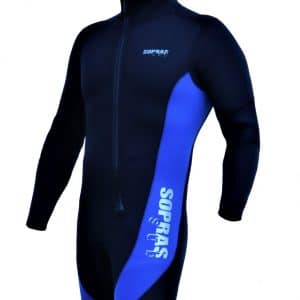
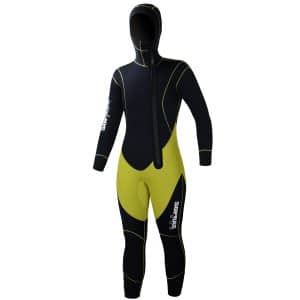
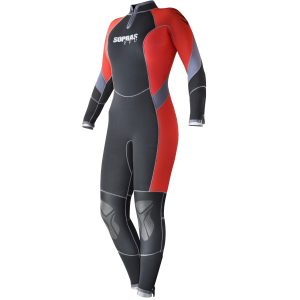
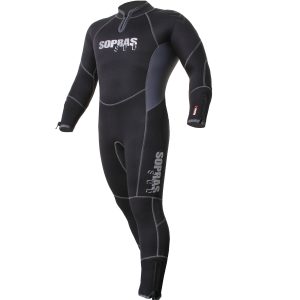
5 mm wetsuits cover the most frequently needed thermal range for recreational diving: water temperatures between 18–24°C, which includes Mediterranean diving, early-season and late-season temperate water, and Central European surface diving in summer. Nine models cover a full range from entry-level suits (Antibes 5mm, CIPRO) through mid-range stretch options (Amalfi, Cannes Man) to high-performance extrastretch construction (Freddo Extreme) and the smooth-skin WHALE skinsuit for freediving and snorkeling applications.
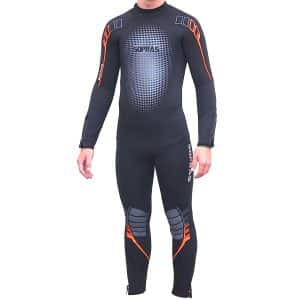
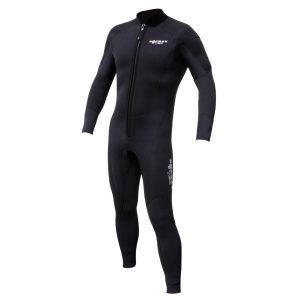
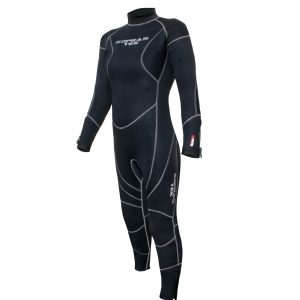
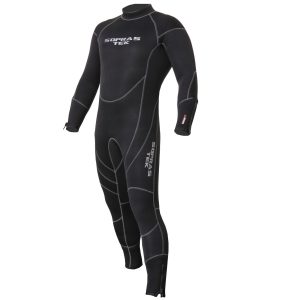
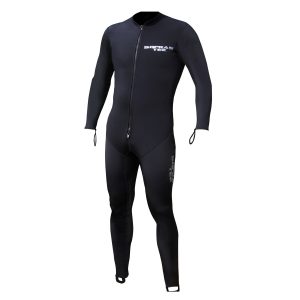
5mm Suit Applications and Model Overview
A 5 mm wetsuit is the most versatile thickness in the range — thick enough to provide meaningful thermal protection in water that feels cold after 30 minutes without protection, thin enough to be comfortable on the surface in Mediterranean conditions and for entry and exit without overheating. Divers who travel internationally and want a single suit that covers the widest range of destinations without committing to either a 3 mm or 7 mm suit will find a 5 mm the most practical choice.
The Antibes Man 5mm and Antibes Lady 5mm are the foundational models in this thickness: standard neoprene construction, back-zip entry, nylon lining, and a conventional size range. The Antibes 5 mm is the reference-point suit against which the other models in this category add specific performance features. The CIPRO 5mm is a similar construction positioned as an alternative fit option — different panel shaping that may suit body proportions that the Antibes doesn’t fit correctly.
The Amalfi Lady 5mm and Amalfi Flex Man 5mm represent the mid-range stretch upgrade. The Amalfi Flex Men’s suit uses partially stretch neoprene in the shoulder, arm, and knee panel areas — the regions where conventional neoprene most restricts movement — while maintaining standard neoprene in the torso panels where thermal performance is the priority. This targeted stretch construction provides meaningfully better arm mobility for photographers and active swimmers without the full price premium of an all-stretch construction. The Cannes Man is a newer addition to the 5 mm range with updated panel geometry.
The Freddo Extreme Man extrastretch 5mm and Freddo Extreme Lady extrastretch 5mm use superstretch neoprene throughout, as in the 7 mm version of the same line. At 5 mm, the mobility benefit of the extrastretch construction is even more pronounced than at 7 mm, because 5 mm conventional neoprene is already more flexible than 7 mm — the gap between standard and extrastretch is smaller in absolute terms, but the Freddo’s all-stretch approach remains the easiest-donning, most movement-permissive suit in the 5 mm category.
The WHALE skinsuit 5mm is a distinctly different construction: smooth-skin neoprene on the exterior rather than fabric laminate. Smooth-skin neoprene repels water rather than absorbing it, which reduces water drag at the suit surface — relevant for surface swimming speed in snorkeling and freediving applications. The WHALE is not the suit for entry/exit over rocks (smooth-skin tears on abrasion far more easily than fabric-laminated neoprene) but is the correct choice for warm-water freediving and snorkeling where streamlining and minimal water absorption are priorities.
What to Look For
- Stretch construction matched to your activity. If your diving involves significant upper body movement — underwater photography, wreck penetration requiring contorted positions, strong current work — the Amalfi Flex or Freddo Extreme stretch constructions provide a tangible efficiency benefit by reducing the resistance of the suit against arm and shoulder movement. For less active recreational diving with a simple flutter-kick descent and ascent, standard construction is thermally equivalent at lower cost.
- Smooth-skin (WHALE) only for specific applications. The WHALE skinsuit requires careful handling — avoid dragging it over rocks, boat gunwales, or rough surfaces. It is appropriate for dedicated snorkeling and freediving use, not for scuba diving from rocky entries where the suit will contact abrasive surfaces repeatedly. If you do both scuba and freediving, a fabric-laminated 5 mm is the more practical general-purpose suit and a separate thin smooth-skin or lycra suit is a better freediving choice.
- Sizing for ladies’ vs. men’s models. Ladies’ models in this range (Antibes Lady, Amalfi Lady, Freddo Extreme Lady) have panel geometry shaped specifically for female body proportions — narrower shoulders relative to hips, adjusted torso length, and differently positioned seams. Female divers should use the ladies’ models rather than sizing down in a men’s suit, as the panel geometry difference affects both fit comfort and seal effectiveness at the wrist, ankle, and neck.
- Internal lining texture and skin contact. All fabric-laminated 5 mm suits here use a nylon or similar lining on the interior. Check the interior surface texture by hand — rougher textures feel more abrasive against bare skin over extended dives, particularly in the inner arm and inner knee areas where the suit slides against the skin during movement. Smooth, tightly woven interior fabrics are preferable for longer dive durations.
- Zipper length and position for independent donning. All suits here use back-zip entry. The zipper should reach high enough on the back to allow the suit to be opened wide for donning, and the pull cord should be long enough to be reached by the opposite hand without assistance. Test this before purchase by putting the suit on without help — if the zipper pull is inaccessible for a solo diver, the suit is impractical for independent use.
Maintenance and Care
Rinse 5 mm suits inside and out with fresh water after every salt water dive. The WHALE skinsuit requires particular care: rinse the smooth-skin exterior gently without scrubbing — the smooth surface can develop surface micro-tears from abrasive cleaning that create channels for water absorption, negating the drag-reduction benefit of the construction. Allow the WHALE to dry in shade, as UV exposure degrades smooth-skin neoprene faster than fabric-laminated neoprene. Apply a silicone-based conditioner to the smooth-skin exterior after each salt water rinse to maintain the material’s surface properties.
For fabric-laminated 5 mm suits, the interior lining should be fully dried before storage. Folding a damp suit and storing it in a gear bag for more than a few hours creates conditions for mold growth in the lining fabric, which produces odor that is difficult to eliminate and slowly degrades the lining adhesive bond. Hang dry completely, interior facing out, in a ventilated area away from direct sunlight before storage. Store on a wide wetsuit hanger — the same principles apply as for 7 mm suits, though the lighter weight of a 5 mm suit creates less stress on standard hangers than a 7 mm.
FAQ
Is a 5mm suit appropriate for diving in the Mediterranean or Red Sea?
Mediterranean surface temperatures range from 13–28°C depending on location and season; at depth, temperatures drop to 12–15°C year-round below the thermocline. For summer Mediterranean diving in the 20–28°C range staying above 20 m, a 3 mm suit is adequate and a 5 mm may be warm. For dives below the thermocline (typically below 20–30 m), a 5 mm provides comfortable protection. For spring and autumn Mediterranean diving when surface temperatures are 15–20°C, a 5 mm is the correct choice throughout the dive profile. Red Sea water is typically 22–27°C year-round — a 3 mm is generally appropriate, and a 5 mm is used by divers who run cold or plan deeper dives.
Can I use a 5mm suit for Czech lake diving in summer?
Yes — Czech and Slovak quarries and lakes have surface temperatures of 20–24°C in peak summer, dropping to 10–12°C at the bottom. A 5 mm suit is comfortable in the surface layer and provides adequate protection for short bottom excursions in the 10–12°C zone. For extended bottom time at depth, a 7 mm suit is more appropriate. Many Czech recreational divers use a 5 mm suit throughout summer and switch to 7 mm in late autumn and spring.
What is the CIPRO suit’s main characteristic compared to the Antibes?
The CIPRO is an alternative panel geometry option at the same 5 mm thickness as the Antibes Man 5mm. Its panel layout provides a different fit profile — notably at the shoulder and upper torso — that suits some body proportions better than the Antibes geometry. If the Antibes fits correctly across the shoulders but is tight in the upper chest, or vice versa, the CIPRO is worth trying as an alternative before moving to a stretch construction. In thermal and durability terms, the two are equivalent.
Can a 5mm and a 7mm suit be combined for extreme cold?
Layering two wetsuits is possible but creates significant restriction problems — the outer suit’s interior dimensions are not designed to accommodate the added thickness and rigidity of a suit underneath, which creates compression at the joints and significantly reduces the mobility of both suits. A more effective approach for extreme cold is to use a 7 mm suit with a 3 mm neoprene undervest underneath (available in the Accessories – Others subcategory), which adds torso warmth without the joint restriction of a full layered suit.
How do I size a 5mm wetsuit for the best thermal performance?
For optimal thermal performance, the suit should fit snugly without restricting breathing — the test is to take a full deep breath while wearing the suit and verify that the chest expansion is not resisted significantly by the neoprene. The suit should sit flush against the skin across the torso without areas of loose fabric, particularly at the lower back and armpits, where gaps allow water pooling and heat loss. At the same time, there should be no painful pressure points on the knees, elbows, or across the shoulders. A suit that meets these criteria at rest and on movement is correctly sized.