

Showing all 7 results
6 and 7 mm wetsuits are the standard thermal protection for cold-water recreational diving in European conditions — quarries, lakes, and coastal sites where bottom temperatures range from 8–15°C year-round. Models here cover conventional 7 mm construction (Antibes, Islanda), high-stretch 7 mm neoprene (Freddo Extreme extrastretch), and the Alaska semi-dry suit for maximum warmth without transitioning to a drysuit.
When to Choose 6/7mm
The 7 mm threshold represents the practical upper limit of standard wetsuit thermal protection. Below approximately 10–12°C water temperature, even a well-fitted 7 mm wetsuit limits bottom time to 30–40 minutes before meaningful core temperature decline begins. Above 18–20°C, a 7 mm suit creates overheating on the surface and is unnecessary. The practical sweet spot for 7 mm suits is 10–18°C — exactly the range that characterizes most Central European inland diving and North Atlantic coastal diving throughout the dive season, from late spring through autumn.
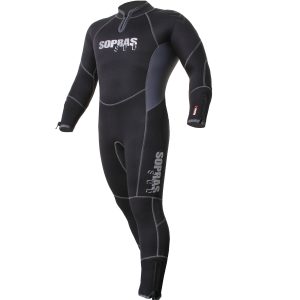
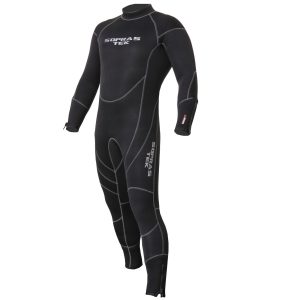
The Antibes Man 7mm and Antibes Lady 7mm are the foundational models: conventional 7 mm neoprene with standard flatlock-and-blind-stitch construction, back-zip entry, and straightforward panel geometry sized across the standard size range. These suits are the cost-effective, durable choice for recreational divers entering cold-water diving for the first time. The Antibes construction has been refined over many production runs and represents reliable, predictable thermal performance.
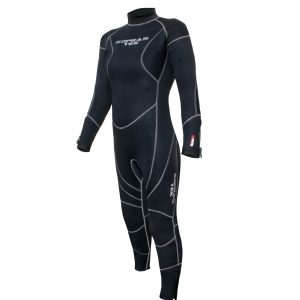
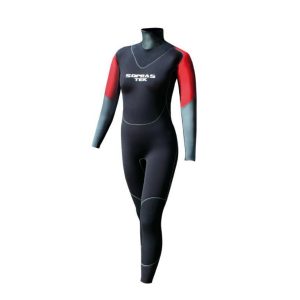
The Islanda Man 7mm and Islanda Lady 7mm are the premium conventional 7 mm option — heavier plush interior lining for additional warmth and comfort against the skin, improved seam construction, and a more anatomically shaped panel geometry that reduces the bunching at the knees and armpits that causes restriction and thermal gaps in simpler designs. For divers who dive cold water frequently and feel the difference over an extended dive day, the Islanda’s construction quality is worth the price increase over the Antibes.
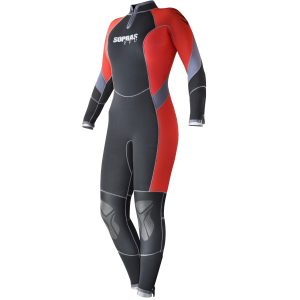
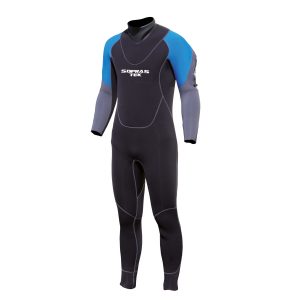
The Freddo Extreme Man extrastretch 7mm and Freddo Extreme Lady extrastretch 7mm use a superstretch neoprene compound throughout the suit. This material stretches in multiple directions under significantly less force than standard neoprene, which means the suit goes on more easily, conforms more closely to the body during movement, and doesn’t restrict the shoulder, knee, and hip range of motion that limits diver efficiency in stiff conventional neoprene. The thermal value is equivalent to standard 7 mm — the difference is entirely in mobility and donning ease.
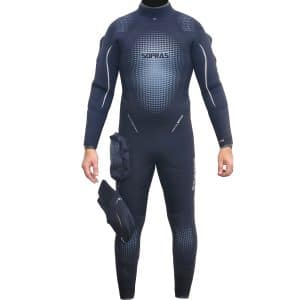
The Alaska semi-dry man is a different category of product. Semi-dry suits incorporate wrist, ankle, and neck seals that are fitted much more tightly than standard wetsuit openings, minimizing the continuous water exchange that occurs when a diver moves in a conventional wetsuit. In cold water, this exchange is the primary mechanism of heat loss — body-heated water is flushed from the suit and replaced with cold water with every arm stroke and kick. The Alaska’s sealing significantly reduces this flush rate, maintaining a warmer water layer inside the suit for longer. It is appropriate for divers who regularly dive below 12°C and are not yet committed to the additional maintenance and certification complexity of a drysuit system.
What to Look For
- Interior lining type. 7 mm suits are available with smooth nylon-lined interiors (faster to don but cooler against the skin) and plush interior linings (warmer, more comfortable, but slower to dry). The Islanda and Made-to-Measure suits use plush lining; the Antibes uses standard nylon. For divers making multiple dives per day from a boat, a faster-drying nylon-lined suit may be more practical. For single-dive-per-day diving in the coldest conditions, plush interior provides a measurable comfort advantage.
- Wrist and ankle seal fit. In 7 mm suits, the wrist and ankle openings are the primary water entry points. The sleeve cuff should grip the wrist without creating a pressure point over the radius bone, and the ankle should seal against the foot without gapping when the knee is fully flexed. Test these seals specifically when trying suits — the overall suit may fit correctly while the sleeve length is too short, leaving the wrist seal sitting over the hand rather than the wrist.
- Semi-dry vs. standard for your dive profile. The Alaska semi-dry is the correct choice if you regularly dive below 12°C for more than 30 minutes per dive, dive multiple times per day in cold water, or experience significant cold discomfort in a standard 7 mm suit toward the end of a dive. If you dive cold water occasionally and primarily stay in the 12–15°C range for shorter recreational dives, a well-fitted standard 7 mm Islanda or Freddo Extreme is sufficient and involves less maintenance complexity than a semi-dry.
- Stretch requirement for your activity level. The Freddo Extreme’s superstretch construction provides a genuine advantage for active divers who make fast fin movements, underwater photography requiring contorted positions, or overhead diving in confined spaces. For less active recreational divers on guided reef or wreck dives with modest physical demands, the thermal and seal performance of the standard Antibes or Islanda is equivalent at lower cost.
- Size range for your body proportions. Standard sizes cover most body types, but particularly tall or heavily built divers often find that 7 mm suits are tight across the shoulders and short in the torso simultaneously. If you are between sizes, size up for the torso length — a suit that’s slightly loose at the waist but reaches the wrist correctly is thermally superior to one that fits the shoulder but leaves a gap at the ankle.
Maintenance and Care
Rinse 7 mm suits inside and out with fresh water immediately after every dive in salt water. Salt that dries inside the thick neoprene core is more difficult to fully remove than in thinner suits, and accumulated salt crystals abrade both the interior lining and the skin on subsequent dives. Rinse the interior thoroughly by filling the suit partially with fresh water and working it through the interior by hand before draining. Allow the suit to dry completely — 7 mm neoprene retains moisture longer than thinner suits, and storing a damp suit in a gear bag between sessions accelerates mold growth and neoprene degradation.
Hang 7 mm suits on wide-framed wetsuit hangers rather than standard clothes hangers — the weight of a fully saturated 7 mm suit on a standard hanger concentrates all load on a single contact point and permanently deforms the shoulder seam and adjacent neoprene. Store suits hung vertically so the weight is distributed along the full shoulder width, or fold over a horizontal bar at the waist. Do not store suits in a compressed or rolled position for more than a few hours.
For the Alaska semi-dry, pay particular attention to the seal areas at wrist, ankle, and neck during rinsing. Salt deposits in the tighter sealing surfaces of a semi-dry suit can cause the seals to stiffen and crack faster than the suit body, and a damaged seal defeats the thermal advantage of the semi-dry design. Inspect the seal edges after every few dives for small tears or surface cracking and address them with neoprene adhesive before they propagate into a full seal failure. The zipper of the semi-dry should be waxed with appropriate zipper lubricant every 3–5 dives to maintain smooth operation — a semi-dry zipper is under significantly more tension than a standard wetsuit zipper.
FAQ
Is a 7mm wetsuit enough for diving in Czech quarries year-round?
A well-fitted 7 mm wetsuit is adequate for Czech quarry diving from spring through autumn at recreational depths, where bottom temperatures are typically 8–12°C. For winter diving when air temperatures are also cold (which increases heat loss during the surface intervals between dives), or for extended bottom times beyond 30–40 minutes, a 7 mm suit approaches its thermal limits and many divers find they need the additional protection of a semi-dry or drysuit. The Alaska semi-dry in this category is the appropriate step up from a 7 mm suit before committing to a full drysuit system.
What is the difference between the Antibes 7mm and the Islanda 7mm?
Both are conventional 7 mm wetsuits in neoprene thickness and thermal performance. The Islanda has a plush interior lining that provides additional warmth against the skin and is significantly more comfortable to wear against bare skin over extended dives, while the Antibes uses a standard nylon interior lining that dries faster between dives. The Islanda also has more refined anatomical panel shaping that reduces material bunching at the knees and shoulders, which improves both comfort and effective insulation (bunched neoprene is compressed neoprene, which has reduced insulation value). The Islanda is the premium choice; the Antibes is the practical everyday suit.
Is the Alaska semi-dry suitable as a stepping stone before buying a drysuit?
Yes — the Alaska semi-dry occupies exactly the gap between a conventional 7 mm wetsuit and a drysuit. It provides significantly better cold-water performance than a standard 7 mm without the investment, maintenance complexity, or additional training that a drysuit requires. Many divers use a semi-dry suit indefinitely rather than transitioning to a drysuit, particularly if they dive primarily in the 8–12°C range where a semi-dry performs well rather than the sub-8°C conditions where a drysuit becomes the only practical option.
Can the Freddo Extreme be worn with a drysuit liner?
The Freddo Extreme is a wetsuit, not a drysuit — it is not intended to be worn with a thermal undersuit in the way a drysuit is. However, thin neoprene undervests or rash guards (available in the Accessories – Others subcategory) can be worn under any of the 7 mm suits for additional core warmth, at the cost of making the suit slightly more difficult to don. The Undervest 3mm is the relevant product for this use case.
Why is the Freddo Extreme more expensive than the Antibes at the same thickness?
Superstretch neoprene — the compound used throughout the Freddo Extreme — is significantly more expensive to manufacture than standard neoprene. The raw material cost difference flows directly through to the retail price. The premium reflects a real material difference: superstretch neoprene requires more complex processing to achieve the same thermal value at higher elasticity, and it maintains that elasticity reliably over a longer service life than standard neoprene. Whether the mobility and donning benefit justifies the price difference depends on how frequently you dive and how physically demanding your diving is.