

Showing 1–12 of 16 results
This section covers the surface-side equipment required to transport, handle, protect, and maintain diving tanks: rubber boots for cylinder bases, protective transport nets, carrying handles and trolleys, argon tank holders for dry suit inflation cylinders, valve dust caps in plastic and aluminium, silicone lubricants, and tank straps. None of these items are in-water diving equipment — they support the safe and practical management of cylinders on land, at the dive site, and during storage.

Tank Boots and Protective Equipment
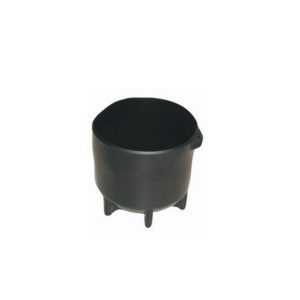
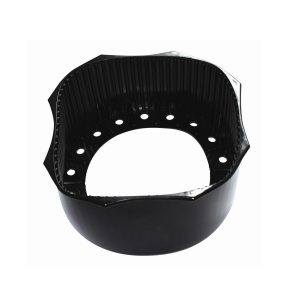
A mono tank boot fits over the rounded base of a steel cylinder to give it a stable flat footing on deck, concrete, and boat surfaces. Three diameter variants are available — 140 mm, 171 mm, and 203 mm — corresponding to the external diameters of the standard tank sizes in the range. The aluminium-specific boot for 7.25″ (184 mm) aluminium tanks is a separate item, sized for the wider body of S80-equivalent aluminium cylinders. Boots are moulded rubber with a solid base and a friction-fit interior; they do not require adhesive and can be removed for tank inspection. A protective transport net stretches over the full cylinder body and provides impact cushioning and surface scratch protection during transport in vehicle boots, dive bags, and boat storage areas where tanks may contact each other or hard surfaces.
Carrying and Transport Accessories
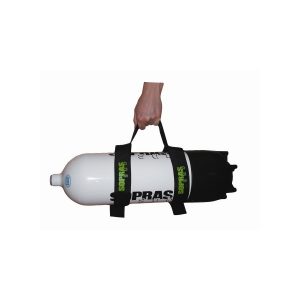
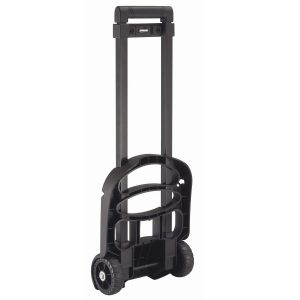
The tank carrying holder is a moulded grip handle that attaches around the cylinder body, providing a comfortable lift point for carrying a single tank short distances without needing to grip the valve or neck. For moving multiple tanks over longer distances, the tank carrier cart is a wheeled trolley designed to hold one or two cylinders upright, with handles and wheel configuration for rolling across flat surfaces at dive sites and marinas. A standard tank carrier (strap-type) is also available for single-cylinder shoulder or hand carry.
Argon Tank Holders
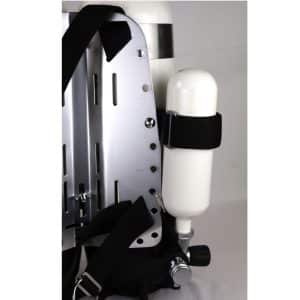
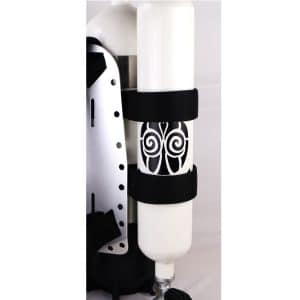
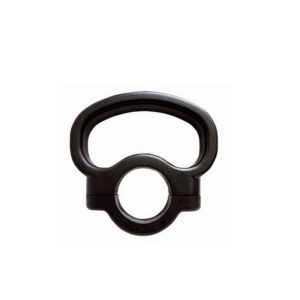
Dry suit divers using argon as the inflation gas carry a small argon cylinder — typically 1 litre or 3 litres — mounted to the main tank or backplate. The argon tank holder is a stainless steel or aluminium band-and-bolt clamp that fixes the argon cylinder to the body of the main tank, keeping it within the diver’s silhouette and securing it against movement during the dive. Both 1-litre and 3-litre holder sizes are available, corresponding to the two common argon cylinder diameters.
Valve Dust Caps and Lubricants
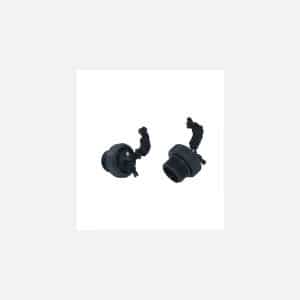
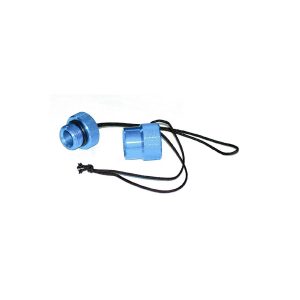
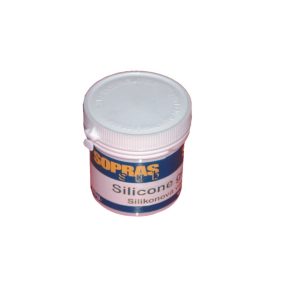
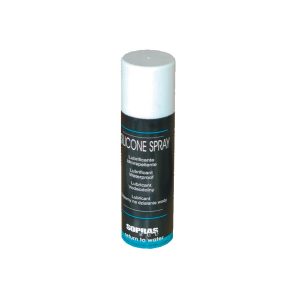
Dust caps seal the valve regulator port when no regulator is connected, preventing contamination of the O-ring seat and the valve body interior by dirt, salt, sand, and moisture. A plastic dust cap provides basic port protection for storage and transport; the aluminium dust cap is a heavier, more durable version suitable for repeated use and rough handling environments. Silicone grease and silicone spray are used for O-ring lubrication at the regulator-to-valve connection, for valve body O-ring maintenance, and for general diving equipment seals. Only silicone-based lubricants should be used on oxygen-service equipment — petroleum-based greases are incompatible with high-pressure oxygen and create a combustion risk.
What to Look For
- Boot diameter matched to your tank body. The mono tank boot is sized by the external diameter of the cylinder — 140 mm, 171 mm, or 203 mm. Check the tank specification before ordering. An incorrectly sized boot will not seat correctly and may slip off during handling.
- Argon holder sized for your argon cylinder. The 1-litre and 3-litre argon holders are not interchangeable — they are sized to the external diameter of the respective cylinder. Confirm which argon tank size you are using before selecting a holder.
- Aluminium dust cap for frequent removal environments. If you attach and remove regulators multiple times per day (instructor, dive guide, or high-frequency diver use), the aluminium dust cap is more durable than the plastic version and maintains a tighter fit over time.
- Silicone grease vs. silicone spray. Silicone grease is thicker and remains in place on O-rings during assembly; silicone spray is thinner and suited for general rubber seal conditioning and equipment that cannot be disassembled for greasing. For regulator O-rings and valve seats, use silicone grease applied sparingly with a fingertip.
Maintenance and Care
Rinse all rubber accessories in fresh water after salt water exposure. Tank boots accumulate salt, sand, and biological debris in the interior — remove the boot periodically, rinse both boot and tank base, and allow to dry before refitting to prevent trapped moisture accelerating corrosion at the tank base. Inspect protective nets for torn mesh before transport — a net with broken cords will not provide impact protection. Argon tank holder bolts should be checked for tightness before each dive; stainless hardware does not corrode but bolt tension can relax over time with repeated thermal cycling. Replace dust caps that have cracked, deformed, or lost their thread engagement — a damaged cap provides no protection and may be difficult to remove cleanly.
FAQ
Do I need a tank boot, and which size fits my cylinder?
Most steel diving cylinders have a hemispherical base and require a boot to stand upright. Without a boot, the tank cannot be left standing and must be laid on its side — a significant practical inconvenience at a dive site. The correct boot diameter matches the external body diameter of your cylinder: 140 mm for smaller-diameter cylinders (typically up to 7 litres), 171 mm for mid-range cylinders (12-litre 171 mm body), and 203 mm for standard European 12-litre, 15-litre, and 18-litre cylinders. The aluminium-specific boot is for S80-equivalent aluminium tanks only.
Why use argon instead of air for dry suit inflation?
Argon is a noble gas with significantly lower thermal conductivity than nitrogen or air. When used as a dry suit inflation gas, the argon layer inside the suit provides better thermal insulation than an air layer of the same thickness. This makes argon inflation the preferred choice for cold water diving — typically below 15°C — where thermal protection margins are critical. The argon tank is a fully independent cylinder carried specifically for suit inflation; it is not breathed, and the inflation regulator connects only to the dry suit inflation valve.
Can I use petroleum-based lubricants on diving valve O-rings?
No. Petroleum-based greases and oils must never be used on diving equipment O-rings or valve seats, particularly on equipment used for oxygen-enriched mixes. Hydrocarbons are combustible and can react violently with high-pressure oxygen. Only purpose-formulated silicone lubricants — silicone grease for O-rings in compression, silicone spray for general conditioning — should be used. This is a safety requirement, not a preference.