

Showing all 6 results
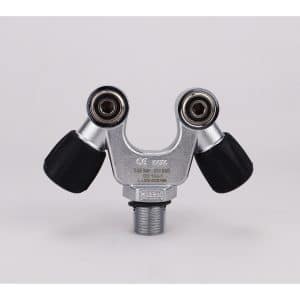
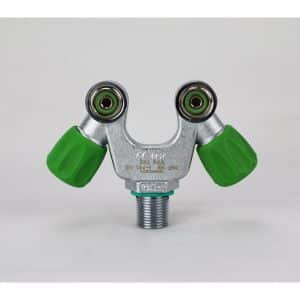
Dual-port valves provide two independent regulator connection points on a single cylinder, allowing the diver to connect two first stages — a primary and a backup regulator, or a regulator and a dedicated pressure gauge — to one tank. The range includes H valves (two parallel ports at the top of the valve body) and V valves (two ports at an angle from a central body), in standard EN 144, 300-bar, nitrox, adjustable, and screw model variants.
Products in This Category
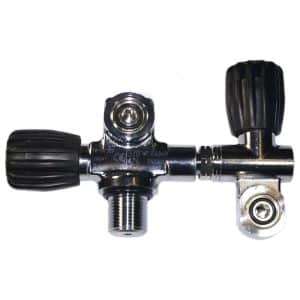
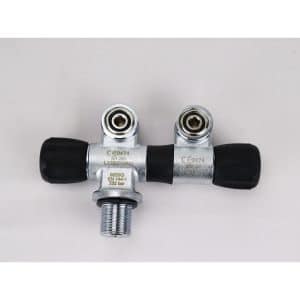
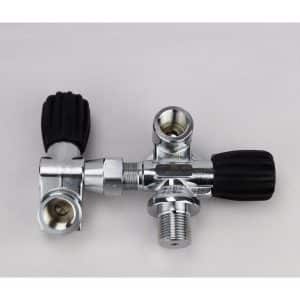
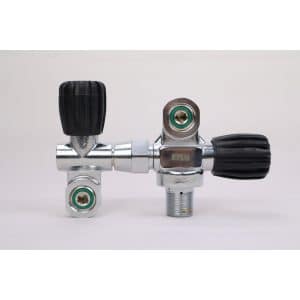
Six dual-port valve models are available. The Right H Valve EN 144 (SKU 734232/735233) is a standard 232-bar H-valve in two sub-variants, providing two G 5/8″ DIN ports. The Right H valve 300 bar (SKU 737300) is the 300-bar rated equivalent for high-pressure cylinder configurations. The H valve (2 ports) model screw (SKU 742246/247) is an H-valve with a screw-in second outlet mechanism that allows one port to be sealed when not in use. The Left Double valve adjustable (SKU 732200) is a V-valve design with an adjustable angular separation between the two outlet ports, enabling the diver to optimise the angle for their specific regulator and hose configuration. The V valve (SKU 731200) is the standard fixed-angle V-valve for two-regulator single-cylinder setups. The V valve Nitrox-G5/8 regul.connect. (SKU 739200) is the nitrox-rated dual-port variant with oxygen-compatible seals for EAN-dedicated cylinders.
H Valve vs. V Valve Configurations
In an H valve, the two regulator ports emerge from the top of the valve body parallel to each other, with the on/off spindle between them — the assembly profile viewed from above resembles the letter H. Both ports are independently usable; when one first stage is connected, the other port can be blanked with a dust cap or connected to a second first stage. The screw model H valve replaces one of the DIN ports with a screwed outlet: one port functions as a standard DIN regulator connection, while the second outlet requires a purpose-made screw connector — typically used to attach a second pressure gauge hose or a pony regulator directly without a full first-stage body.
In a V valve, the two ports exit the valve body at an angle from a central spindle axis — the angle can be fixed or, in the adjustable model, set between approximately 45° and 180°. The adjustable configuration is useful where two large first-stage bodies on a single cylinder would otherwise contact each other or the diver’s BCD/backplate at a fixed angle. Both H and V configurations achieve the same practical goal; the choice is driven by diver preference, equipment configuration, and training guidance.
What to Look For
- Pressure rating for your cylinder. The standard H and V valves are 232-bar; the Right H valve 300 bar is required for 300-bar cylinders.
- Nitrox service. The V valve nitrox model is for EAN-dedicated cylinders. Standard H and V valves require oxygen cleaning before use with nitrox mixes above 21%.
- Port angle for your equipment configuration. If you intend to run two full regulator first stages on one cylinder, measure the combined width of the two first-stage bodies and confirm clearance at the available port angle before ordering a fixed-angle valve. The adjustable model eliminates this uncertainty.
Maintenance and Care
Dual-port valves have two DIN bore O-rings — inspect and replace both during annual service. When only one port is in use, keep the unused port capped with a dust cap at all times. The burst disc on a dual-port valve is located in the valve body and serves both ports; it is matched to the valve’s working pressure. All general valve maintenance guidance from the Valves category applies. The adjustable V-valve pivot mechanism should be inspected during service — the adjustment bolt and locking mechanism must be fully tightened before the valve is used under pressure.
FAQ
Do I need two regulators to use a dual-port valve?
No. A dual-port valve can be used with one regulator connected to one port and a dust cap on the second port. This is common when a diver wants the option to share air with a buddy directly from their own tank without removing their regulator, or when a second port is reserved for a different gas phase on a future dive. However, the primary reason most divers select a dual-port valve is to connect two independent regulators for redundancy — having an independent backup regulator and first stage on the same cylinder provides a bail-out option without a separate pony cylinder.
What is the “right” configuration in the H valve designation?
The right/left designation on H valves indicates the side from which the valve spindle handle projects relative to the regulator ports facing the diver. A right H valve has the handle on the right side; left configuration on the left. In backmount single-cylinder diving, a right H valve positions the spindle handle toward the diver’s right hip — the convention in many H-valve setups where the handle must be accessible for valve shutdown drills. Check your training agency’s equipment configuration guidance for the correct orientation for your specific use case.