

Showing all 5 results
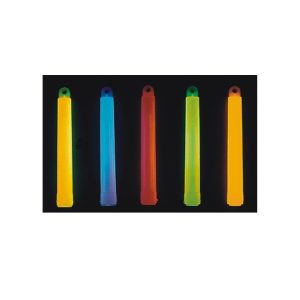
This category covers underwater and surface signalling lights — chemical light stickers, electronic signalling sticks in constant and flashing modes, strobe flash units, and a wrist-mounted lamp holder. These are visibility and emergency signalling devices rather than primary dive illumination torches: their function is to make the diver visible to a dive boat, safety personnel, or buddy at the surface or in low-visibility conditions. All items in this range are passive or low-power devices intended as backup safety equipment carried on every dive.
Signalling Lights: Function and Use Cases
A signalling light serves a different purpose from a primary torch or video light. Where a primary torch illuminates the underwater environment for the diver’s own navigation and visibility, a signalling light makes the diver detectable by others — at the surface after the dive, during a safety stop in open water, in conditions where the diver has become separated from the group, or as a night dive marker visible to the boat crew. They are small, lightweight, and in most cases single-use or long-life items designed to be carried on every dive as standard safety equipment rather than deployed only on specialist dives.
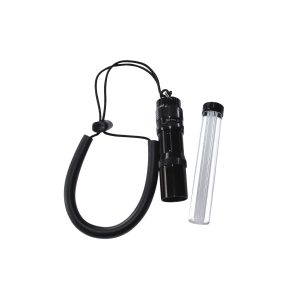
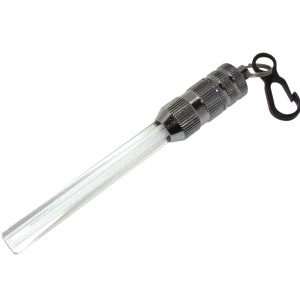
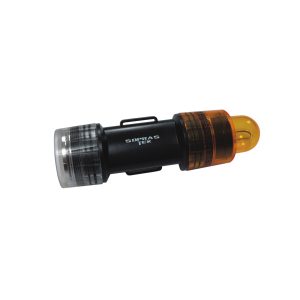
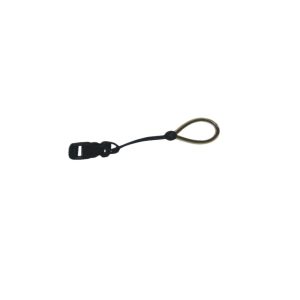
The five products in this category represent three technology types. Chemical light stickers (cyalume-type) are passive photochemical devices with no battery, no switch, and no failure mode other than physical damage — they activate on bending and produce green light for several hours. They are attached directly to equipment, suit, or tank. Electronic signalling sticks — the full-size Signalling stick and the smaller Small signalling stick — are battery-powered devices with LED output in constant-on and flashing (strobe) modes. The full-size model is available in two brightness variants; the small model in constant and flashing mode variants. The Strobe flash light (SKU 805910) is a dedicated electronic strobe unit with a higher-intensity flash output and a broader flash angle, designed for surface use in open water or rough sea conditions where a continuous-beam torch would not be visible at distance. The wrist-mounted lamp holder is a silicone or rubber mounting bracket worn on the wrist to hold a small signalling light, freeing the hands while keeping the light visible and accessible.
When and How to Carry Signalling Lights
The minimum recommended configuration for open water diving is one signalling device per diver — either a chemical light sticker attached to the tank or suit, or an electronic signalling stick clipped to the BCD. In night diving, a signalling light visible from above is standard practice both for boat crew awareness and for buddy identification in low visibility conditions. For liveaboard, drift diving, or any diving environment where separation from the boat is a realistic scenario, a high-visibility strobe is appropriate as a dedicated surface signal alongside the primary signalling device. Chemical light stickers are the lowest-cost, lowest-bulk option and are suitable as a minimum baseline; electronic sticks provide controllable on/off operation and reusability across multiple dives.
What to Look For
- Chemical vs. electronic for your use case. Chemical light stickers are single-use, require no maintenance, and have zero battery failure risk — appropriate as a permanent backup clipped to equipment. Electronic sticks are reusable, switchable, and brighter for active signalling — appropriate as the primary signalling device for planned night or low-visibility diving. Carrying both types provides redundancy.
- Constant vs. flashing mode. Constant light is more easily identifiable as a diver marker in moderate conditions; flashing/strobe mode is more visible at distance in daylight or rough sea because the intermittent flash attracts attention more effectively than a continuous low-intensity light. The full-size Signalling stick is available in brightness variants; the Small signalling stick comes in both constant and flashing mode versions.
- Strobe for surface visibility in open water. The dedicated Strobe flash light provides a high-intensity periodic flash suitable for attracting the attention of a boat crew at range in surface conditions. It is a surface safety device — it is not designed for underwater use as a primary torch.
- Wrist holder for hands-free operation. The wrist-mounted lamp holder allows a signalling stick to be worn continuously without occupying a hand or requiring attachment to the BCD. This is practical for night dives where the signalling light should remain visible throughout the dive rather than only when deployed.
Maintenance and Care
Chemical light stickers are single-use devices — once activated by bending, they cannot be deactivated and begin degrading immediately. Store unused stickers in the original sealed packaging away from heat and sunlight. Check the expiry date printed on the packaging before use; chemical light output decreases significantly approaching the expiry date. Electronic signalling sticks should be rinsed in fresh water after salt water use, paying attention to the switch mechanism and battery compartment seal. Replace batteries at the start of each dive season or after extended storage. Test the device before each dive — switch through all modes and confirm the output is consistent. Inspect the O-ring seal of the battery compartment annually; a degraded O-ring will allow water ingress and destroy the electronics. The wrist holder should be rinsed in fresh water and inspected for cracking or deformation — a holder that cannot retain the lamp securely is a safety failure.
FAQ
Is a signalling light the same as a primary dive torch?
No. A primary dive torch illuminates the underwater environment — it is a wide-beam or spot-beam high-output light used to see in dark, turbid, or deep water conditions. A signalling light is a small, lower-output device whose purpose is to make the diver visible to others rather than to illuminate the environment for the diver. Most divers carry both: a primary torch for illumination and a signalling device as safety equipment. The products in this category are all signalling devices — there is no primary dive torch in this specific range.
When should I use a constant light vs. a flashing mode?
Constant light is useful for buddy identification during the dive — a light visible to your buddy throughout the dive confirms your position continuously. Flashing mode is more effective for attracting attention at the surface, particularly in conditions where a constant light might be mistaken for boat navigation lights or other fixed sources. In an emergency at the surface — waiting for boat pickup, separated from the group — activate flashing mode to maximise the visibility of your signal to rescuers at distance.
How long does a chemical light sticker last?
Activated chemical light stickers typically produce visible light for 8 to 12 hours depending on ambient temperature — output is reduced in cold water, extended in warmer conditions. The stored (unactivated) shelf life is typically 2 to 4 years from manufacture; check the expiry date on the packaging before each season. Do not rely on a sticker beyond its expiry date for safety-critical applications — the photochemical reactant degrades even in the sealed package over time.
Do I need a signalling light for recreational diving?
Most training agencies recommend at minimum one surface signalling device per diver for open water recreational diving — typically a surface marker buoy (SMB) for signalling position before surfacing, and a signalling light for visibility at the surface after ascent. In night diving, a signalling light is standard mandatory equipment. In boat diving environments, the dive operator will typically specify minimum signalling equipment requirements for each diver. A chemical light sticker on the tank is the lowest-barrier option that satisfies the recommendation without adding measurable weight or volume to the kit.