

Showing all 10 results
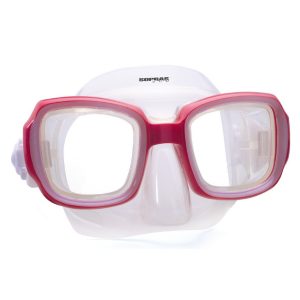
Twin-lens diving masks use two separate tempered glass lenses held in a divided frame, with a nose bridge separating the left and right visual fields. This construction is the most common configuration in recreational diving — the frame rigidity provides reliable structural support, and the divided lens design is compatible with prescription optical inserts for divers who require vision correction.
More masks can be found on SoprasTek or SoprasApnea sites.
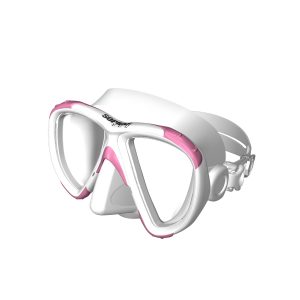
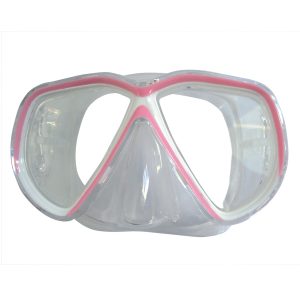
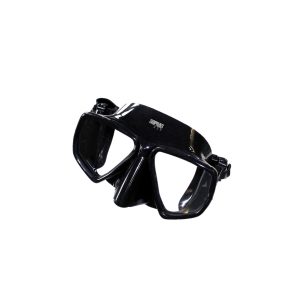
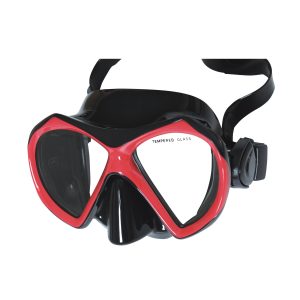
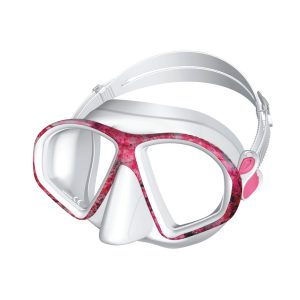
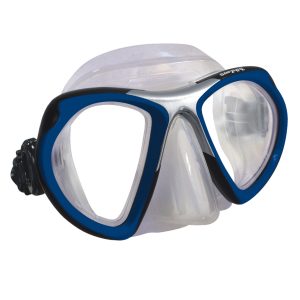
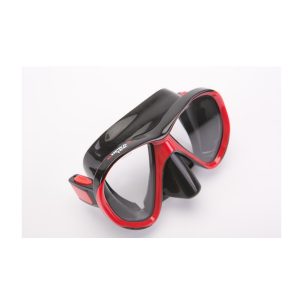
Twin-Lens Construction and Practical Advantages
The two-glass design has been the standard in recreational diving for decades for two reasons. First, the divided rigid frame creates a robust, predictable seal geometry that holds its shape reliably across temperature changes, pressure variations, and physical handling — the frame doesn’t flex or distort the skirt the way a frameless single-lens design can. Second, each lens is independently framed, which means they can be removed and replaced with corrective optical lenses ground to a diver’s prescription. Divers who can’t or don’t want to wear contact lenses underwater should prioritize twin-lens masks for this reason.
The models in this category cover a wide range of skirt profiles and face fit geometries. The Amica and Gentile have compact skirts with narrower nose pockets suited to smaller or narrower face profiles. The BRAVA and Curiosa offer a mid-profile skirt with a balanced field of view. The Leggera is the lightest-construction option with a minimal frame profile. The LUCIDA Aluminium Frame uses an anodized aluminum frame instead of plastic — the frame is more rigid and significantly more impact-resistant, appropriate for technical or industrial diving where equipment takes more physical abuse. The Magica and SHIC are entry-level options with conventional construction.
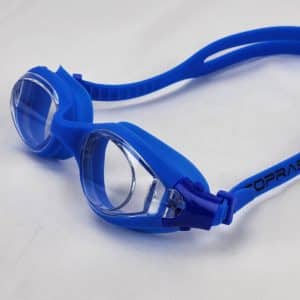
The Swimming goggles listed here are pool/surface swimming goggles rather than diving masks — they do not have a nose pocket and are not suitable for diving below the surface.
Prescription Lenses in Twin-Lens Masks
The most practical approach to vision correction in a twin-lens mask is a bonded optical insert — a corrective lens cut to fit inside the mask frame and bonded over the original lens. This is available from specialist dive opticians for most two-glass mask frames. The correction does not need to be perfectly matched to your full eyeglass prescription because water amplifies apparent lens power; a diopter value roughly 30% lower than your dry land prescription often provides adequate in-water clarity. Alternatively, ready-made insert lenses are available in fixed diopter steps (typically −1.5 to −6 in half-diopter increments) that work without custom grinding for many divers with standard corrections.
What to Look For
- Skirt contact area and nose pocket shape. The lower skirt section around the nose pocket is the most variable part of a twin-lens mask’s geometry — the pocket must sit flush against the sides of the nose without gaps, particularly at the inner corners where the nose meets the cheekbones. This varies significantly between models; the suction test without the strap is the only reliable way to assess fit before diving.
- Frame material for your diving environment. Plastic frames are adequate for recreational diving conditions. If you’re regularly diving in areas with physical hazards — rocky entries, wreck penetration, heavy gear handling — the aluminum frame of the LUCIDA is meaningfully more durable. Aluminum also dissipates heat differently from plastic, which is worth considering in hot climates where the mask sits in direct sun between dives.
- Lens replacement availability. For a twin-lens mask you plan to use long-term, verify that replacement lenses are available for the model. Scratched or cracked lenses are a normal part of the equipment lifecycle; a mask with unavailable spare lenses has a shorter practical service life.
- Skirt stiffness and hood compatibility. Softer silicone skirts conform more easily to irregular face surfaces and seal better around stubble or low cheekbones, but can be displaced by neoprene hoods pressing against the skirt perimeter. If you regularly dive with a 5–7mm hood, a firmer skirt construction like the LUCIDA’s rigid frame assembly maintains a more consistent seal under hood pressure.
- Color variants and skirt transparency. Several models in this range offer both black and transparent/colored skirt options. Black skirts block peripheral light and improve contrast — relevant for photographers. Transparent skirts feel more open and increase perceived field of view for general recreational use. Both options use the same silicone material; the optical choice depends on personal preference and dive application.
Maintenance and Care
Twin-lens masks should be rinsed with fresh water after every dive and dried completely before storage. Pay particular attention to the junction between the lens frame and the silicone skirt — salt water and debris accumulate in this seam and, if left to dry, can cause progressive stiffening of the skirt where it contacts the frame. Use a soft brush (not metal) to clean this area if debris has accumulated. For the aluminum frame of the LUCIDA, rinse thoroughly and ensure the frame-to-skirt attachment points are dry, as salt residue at metal-silicone junctions can accelerate oxidation of the frame surface.
If using prescription optical inserts, remove them for cleaning and store separately from the mask — the adhesive used to bond inserts can be compromised by prolonged immersion in hot fresh water (such as a hot tub rinse), so use room-temperature water for insert cleaning. Inspect the insert bond annually for any edge lifting, which allows water ingress and fogging between the insert and the original lens.
Store twin-lens masks in a protective case, lens side down on a soft surface, or suspended by the strap — storing them lens-up with other equipment on top concentrates weight on the frame and can cause permanent deformation of the frame geometry over time, breaking the lens-to-skirt seal.
FAQ
Can I get prescription lenses for any two-glass mask in this category?
Prescription optical inserts are available for most standard twin-lens mask frames, but fitment depends on the lens dimensions of the specific model. Before ordering inserts, provide the dive optician with the exact mask model name — they will confirm whether ready-made or custom-ground inserts are available for that frame. The LUCIDA Aluminium Frame, Curiosa, and Amica are among the models with established aftermarket optical insert availability.
What is the Mask Leggera’s main characteristic?
The Leggera is distinguished primarily by its lightweight construction — a reduced-profile plastic frame and thinner overall structure make it one of the lighter twin-lens masks in the range. This makes it a good choice for divers who find heavier masks cause discomfort around the forehead and nose bridge during long dives, and for travel where pack weight matters. The trade-off relative to stiffer-frame designs is slightly less structural rigidity under hood pressure.
Why is the LUCIDA frame made from aluminum instead of plastic?
Aluminum provides significantly higher impact resistance and rigidity than injection-molded plastic at similar or lower frame weight. For professional and technical divers who regularly handle their masks roughly — scraping against wrecks, being transported in equipment bags with heavy gear — aluminum frames last substantially longer before cracking or deforming. The aluminum frame also gives the mask a distinctive profile that some divers prefer aesthetically. The functional diving performance is comparable to plastic-framed equivalents of the same skirt geometry.
Is the SHIC mask suitable for scuba diving or only snorkeling?
The SHIC is a standard twin-lens diving mask with a tempered glass lens and silicone skirt — it is fully suitable for recreational scuba diving. It is positioned as an entry-level option with straightforward construction, but the materials and construction meet the same standards as more expensive models in this category. The practical difference between entry-level and mid-range masks in this range is primarily comfort features (skirt texture, buckle system quality) and fit range, not fundamental diving performance.
How often should I replace my diving mask?
There is no fixed replacement interval — a well-maintained mask can last 5–10 years or more. The triggers for replacement are practical: persistent leaking that cannot be resolved by adjusting the strap or cleaning the skirt seal, visible silicone degradation (cracking, stiffening, or surface tackiness on the skirt), scratched lenses that cause visual distortion underwater, or frame cracking that compromises the seal geometry. Annual inspection of the skirt, lens condition, and buckle function is sufficient for recreational users diving a few dozen times per year.