

Showing all 7 results
Regulator hoses connect the first stage LP port to the primary second stage, carrying intermediate-pressure gas — typically 8–10 bar above ambient — to the diver’s mouthpiece. Length, flexibility, and outer construction all affect how comfortably the second stage sits in position and how the hose routes along the BCD harness. The seven products here cover lengths from 62 cm to 210 cm in rubber, extra-soft, smooth, NBR, and braided constructions, including Braided Tek variants for technical diving configurations.
Regulator Hose Function and Length Selection
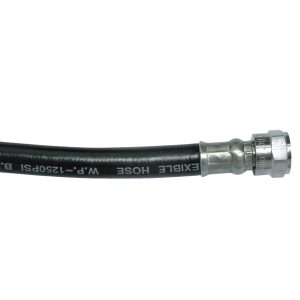
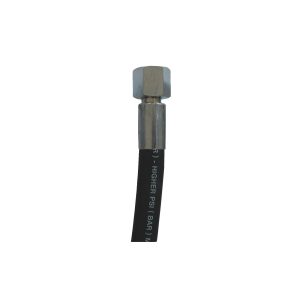
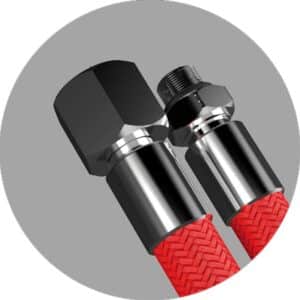
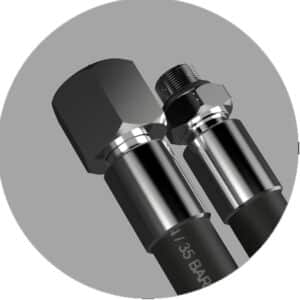
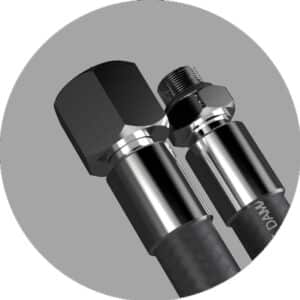
The primary regulator hose routes from the first stage LP port — typically the right rear or right side port on a backmount regulator — over the right shoulder and to the second stage mouthpiece. The geometry of this route determines the correct hose length. In a standard recreational backmount configuration, a 70–75 cm hose places the second stage comfortably at mouth level with the hose lying along the right shoulder without excess slack or tension. The Hose for regulators rubber black is available in six lengths spanning this range and beyond, providing a direct fit for both standard and non-standard configurations. The Extra soft regulator hose and Extra soft regulator hose 70 cm/27.6″ use a particularly flexible inner and outer construction that reduces the effort required to hold the second stage in position when the head is turned — relevant for divers who notice that a stiffer hose pulls the second stage out of the mouth during certain head movements.
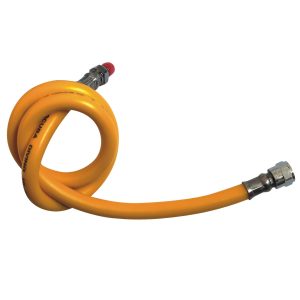
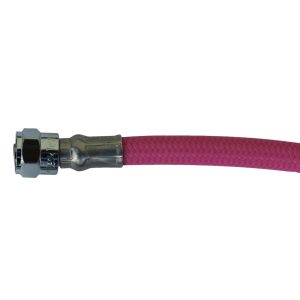
Technical and sidemount configurations use substantially longer hoses. The REGULATOR hoses CLASSIC NBR (62–210) and REGULATOR hoses SMOOTH (62–210) cover the full range from standard recreational lengths to the 100 cm and longer hoses used in long-hose donation protocols, where the primary second stage is routed under the chin and around the diver’s body to allow donation to a distressed diver without the donor having to unclip anything. The REGULATOR hoses Braided Tek (62–105) cover the same range with a braided outer layer suited to technical harness configurations where the hose contacts metal hardware along the routing path.
Construction Types Across the Range
The rubber black construction is the baseline: a reinforced rubber inner tube, a textile braid intermediate layer, and an outer rubber jacket. This construction is adequate for all recreational diving conditions and the majority of technical applications. The NBR (nitrile butadiene rubber) Classic construction provides improved ozone and UV resistance and better cold-water flexibility than standard rubber — particularly relevant at water temperatures below 10°C where standard rubber stiffens noticeably. The Smooth construction replaces the outer rubber jacket with a polyurethane or similar smooth polymer that reduces friction against harness webbing and picks up less sediment at dive sites. The Braided Tek adds a stainless textile braid outer layer for maximum abrasion resistance in technical configurations. The extra-soft series uses a construction optimised for minimum bending stiffness, which reduces the torque the hose applies to the second stage fitting and allows the mouthpiece to maintain its position with minimal effort from the jaw.
What to Look For
- Length matched to your specific configuration. Standard recreational: 70–75 cm. Drysuit over thick undergarment: consider 75–80 cm to compensate for increased shoulder profile. Long-hose technical: 100 cm minimum for under-chin routing; 150–210 cm for full long-hose donation protocol. Sidemount primary: 70–75 cm on the right-side second stage, same as backmount. Do not estimate — route a cord along the intended hose path and measure.
- Flexibility in your water temperature range. Extra-soft, Smooth, and NBR constructions are all more flexible than standard rubber in cold water. If you dive at temperatures below 10°C and the hose pulls the second stage noticeably when you turn your head, a more flexible construction will resolve this without requiring a different length.
- Fitting thread confirmation before installation. All regulator hoses here use 3/8″ UNF at both ends for LP connections. A small number of older or non-standard regulators use metric LP threads. Confirm thread compatibility before installation — cross-threading a regulator LP port is the most common and most avoidable hose installation damage.
- Braided construction for technical harnesses. If the hose routing on your harness passes the hose in contact with a metal backplate edge, a D-ring, or any hardware that creates an abrasion point, a braided outer layer extends hose life significantly versus rubber or smooth constructions at those contact points.
- Outer jacket inspection at each service. The outer jacket of a regulator hose experiences the highest flexing stress at the point where it exits the first stage fitting — this is where surface cracking first appears. Inspect this area specifically at each annual service. A hose showing cracking within 3 cm of either fitting base should be replaced.
Maintenance and Care
Rinse regulator hoses in fresh water after every salt dive. The most effective rinse submerges the hose fully and works the second stage purge button several times to flush salt from the internal passage and the fitting recesses. Allow the hose to drain and dry in a straight or gently curved position — storing in a tight coil induces a permanent bend set over time that puts the hose wall under continuous stress. Braided hoses can be wiped down with a damp cloth to remove sediment from the braid interstices. During annual regulator service, a technician should check the hose for outer jacket integrity, fitting torque at both ends, and signs of inner braid fatigue visible at the fitting exit points.
FAQ
What is the correct hose length for a long-hose technical configuration?
The standard long-hose length for backmount technical diving following the DIR (Doing It Right) protocol is 210 cm (7 feet). This length allows the primary second stage to route under the chin, across the chest, and around the body to reach a distressed diver in front of the donor without requiring the donor to manipulate any equipment. Shorter long-hose configurations of 100–150 cm are used in some sidemount and recreational technical setups where the routing geometry differs. The correct length depends on your specific harness configuration and the protocol you have been trained in.
Why would I choose an extra-soft hose over a standard rubber hose?
An extra-soft hose has a lower bending stiffness than standard rubber, which means it exerts less torque on the second stage mouthpiece fitting when the hose is under any bend or tension. This reduces the tendency for the second stage to rotate out of neutral position in the mouth — particularly noticeable when the diver turns their head in a direction that puts the hose under lateral tension. For divers who find their second stage consistently repositions itself during a dive, an extra-soft hose often resolves the issue without requiring a change in length or routing.
Can I use any of these hoses with nitrox mixtures?
Standard rubber and NBR regulator hoses are generally compatible with nitrox mixtures up to 40% oxygen for recreational nitrox diving at the depths and durations involved. For higher oxygen concentrations — enriched air above 40% or pure oxygen used in technical decompression — hoses must be specifically cleaned for oxygen service and constructed from oxygen-compatible materials. The REGULATOR hoses SMOOTH and Braided Tek constructions should be verified with the manufacturer for oxygen compatibility if used above standard nitrox concentrations. When in doubt, confirm compatibility with the hose manufacturer before use with elevated oxygen mixtures.
Do regulator hoses come with O-rings, or do I need to supply them?
New regulator hoses typically include the required O-rings at both fitting ends. When installing a replacement hose, always use fresh O-rings rather than reusing the ones from the old hose — an O-ring that has been in compression at LP for several years has a deformed cross-section that will not seal as reliably at the correct compression as a new ring. If O-rings are not included with the hose, standard LP regulator fitting O-rings are available from any dive servicing supplier.
How do I route a long hose on a backmount setup?
In a standard long-hose backmount configuration, the primary second stage connects to a 210 cm hose on the right LP port. The hose routes from the first stage, under the right arm, across the front of the body under the diver’s chin, and is stored in a loose drape that sits between the diver’s chest and the tank. A necklace — a bungee loop around the neck — holds the second stage up against the chin when not in use. In an out-of-air situation, the donor extends the second stage forward toward the distressed diver; the 210 cm length allows the hose to run the full length of the donor’s body from behind without the donor having to swim close enough to create entanglement risk.