

Showing all 7 results
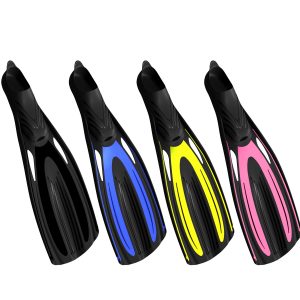
Full foot fins enclose the entire foot in a closed pocket without a separate heel strap, worn directly on bare feet or thin neoprene socks. Lighter and more compact than open-heel designs, they are the standard choice for snorkeling, warm-water recreational diving, and travel — when dive boots aren’t needed and packability matters.
For more fins please check SoprasTek.
Full Foot Fin Design and Applications
The closed-heel design of a full foot fin means the foot pocket wraps completely around the heel, eliminating the heel strap mechanism entirely. This makes full foot fins lighter, structurally simpler, and faster to don and remove than open-heel designs. The trade-off is that sizing is more precise — without an adjustable strap, the foot must fit the pocket closely. A pocket that’s too small causes painful pressure on the toes and metatarsals; one that’s too large allows the foot to move within the pocket, generating blisters at the heel and reducing kick efficiency.
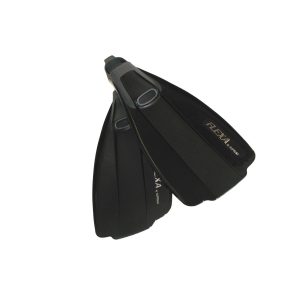
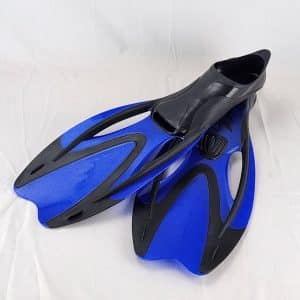
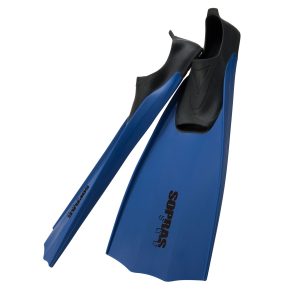
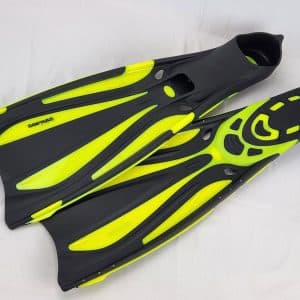
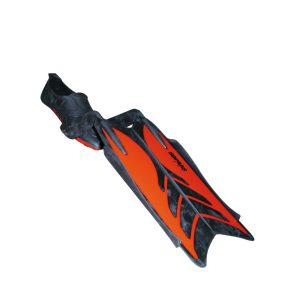
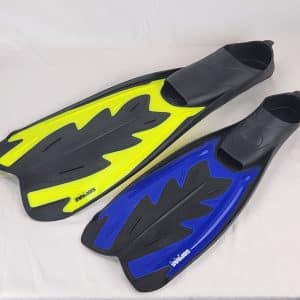
The range here covers snorkeling fins, general-purpose recreational fins, and entry-level fins suited to water parks, dive courses, and warm-water tourism. The Nautilus Snorkeling fins are purpose-built for surface snorkeling — a longer, wider blade generates effortless surface propulsion for extended snorkeling sessions. The FLEXA and SPIDER are mid-length all-purpose fins suitable for both snorkeling and shallow scuba diving in warm water. The Legend and Linea are more refined recreational fins with longer blade profiles. The Veloce II is the closed-heel counterpart to the open-heel Veloce series. The Grillo NEW is a short, lightweight fin suited to pool swimming, children’s use, and entry-level snorkeling.
For scuba divers who travel frequently to warm-water destinations and don’t want to check dive boots in addition to fins, full foot fins reduce packing volume significantly. They function well for recreational diving to 30–40 m in warm water where thermal protection from neoprene boots isn’t required.
Sizing and Foot Pocket Fit
Full foot fins are sized by shoe size — European shoe sizes are the standard reference, and manufacturers provide a size chart converting shoe size to fin size. The foot pocket should fit the foot without gaps at the heel (which allows the heel to lift during the up-stroke) and without pressure on the toe tips (which causes cramping over 30–40 minutes of continuous use). A thumb’s width between the longest toe and the end of the pocket is the standard fit check. Neoprene sock use with full foot fins is common for warm-water divers who want light thermal protection — if you plan to use socks, add one half-size to account for the sock thickness.
What to Look For
- Foot pocket material hardness. Softer foot pocket materials conform more easily to different foot shapes and are more comfortable for extended use, but wear faster at the heel edge under repeated entry-exit abrasion. Harder pocket materials are more durable but less forgiving on foot shape variations. For occasional snorkeling use, soft pocket materials are fine; for regular scuba diving, a more durable pocket construction extends fin lifespan.
- Blade length for your intended use. Longer blades generate more thrust per kick cycle but are physically larger to transport and less maneuverable in tight spaces. For open-water snorkeling covering significant distances, longer blades like the Nautilus Snorkeling fins are genuinely more efficient. For diving in confined environments, reef swimming, or general recreational use, mid-length blades like the FLEXA or SPIDER are a better compromise.
- Drainage channels on the foot pocket sole. Many full foot fins have drainage channels or ventilation slots on the bottom of the foot pocket to allow water to drain when the fin is lifted from the water. Without drainage, the foot pocket acts as a scoop that fills with water, adding weight and causing the heel to slip during the kick cycle. Check for drainage features if you’re using the fins for snorkeling where you regularly lift your feet out of the water.
- Toe pocket construction for comfort. Fins where all five toes are enclosed in a single open pocket generally fit a wider range of foot widths than those with a separated big-toe pocket. For wide feet, an open-toe pocket is more comfortable. Inspect the toe box interior for any seam ridges that run across the top of the toes — these cause abrasion and should be absent in quality construction.
- Heel strap absence implications for entry. Without a heel strap, full foot fins must be donned carefully — pull the heel cup down over the heel first, then work the foot forward into the pocket. Entering the water in full foot fins before the foot is fully seated is a common cause of fin loss; always confirm the heel is fully inside the pocket before entering.
Maintenance and Care
Rinse full foot fins thoroughly with fresh water after every salt water dive, including the interior of the foot pocket. Salt residue inside the pocket abrades bare skin over time and accelerates the degradation of neoprene sock material. Dry the foot pocket interior completely before storage — sealed foot pockets that remain damp develop mold at the interior heel seam, which produces odor that is difficult to remove and accelerates rubber degradation.
Store full foot fins flat or hanging by the blade tip on a clip — do not stack other equipment on top of fins stored flat, as sustained compression on the blade tip area can cause permanent tip curl. UV exposure to rubber fins accelerates surface oxidation (the white chalky surface that develops on aging rubber) — store fins away from direct sunlight when not in use. Periodic application of a silicone-based rubber conditioner to the foot pocket exterior extends rubber flexibility and prevents surface cracking.
Inspect the foot pocket heel area annually for delamination or stress cracking, which occurs where the pocket flexes during the kick cycle. Early-stage cracking that doesn’t penetrate the full pocket thickness can be treated with neoprene cement to prevent propagation. Through-cracks in the heel area allow water ingress that reduces the pocket’s grip on the foot and should be addressed before the fin is used in diving conditions where fin loss is a safety concern.
FAQ
Can I use full foot fins with neoprene socks for scuba diving?
Yes — thin neoprene socks (1–3 mm) are commonly used with full foot fins when light thermal protection is needed or when the fin foot pocket is slightly large. Size the fin with the sock in mind: if your bare foot is a 42, and you plan to wear a 2 mm sock, size the fin at 43. Thicker socks change the foot geometry too much for most full foot fin designs and are better paired with open-heel fins that accommodate the added volume through strap adjustment.
What is the Grillo NEW suitable for?
The Grillo NEW is a short, lightweight fin designed primarily for children, pool swimming, and entry-level snorkeling in calm water. Its short blade produces less thrust than longer recreational fins but is easy to control for smaller or less experienced swimmers, and its light construction makes it comfortable for extended use in pool environments. It is not optimized for open-water snorkeling in any current or for scuba diving, where the blade area is insufficient for efficient propulsion with full scuba gear.
Are full foot fins suitable for scuba diving or only snorkeling?
Full foot fins are fully functional for recreational scuba diving in warm water where neoprene boots aren’t needed. Many experienced warm-water scuba divers prefer full foot fins for their simplicity and lighter weight. The limitation is thermal: without boots, foot thermal protection depends entirely on water temperature tolerance. In water below approximately 24–25°C, most divers begin to find bare-foot diving in full foot fins uncomfortable over a 45–60 minute dive. For water temperatures below 20°C, open-heel fins with neoprene boots are more appropriate.
How do I prevent foot cramps when using full foot fins?
Foot cramps during fin use are most commonly caused by a foot pocket that’s too small — the confined toe space restricts circulation and forces the foot muscles to work against the pocket constraint rather than freely. Verify the fit: there should be space above the toes, the ball of the foot should sit at the widest point of the pocket, and the heel should be fully inside the heel cup without any lifting. Secondary causes include dehydration, cold water (which reduces blood flow to the extremities), and kicking with pointed rather than relaxed toes — consciously relaxing the foot and allowing the fin to do the work rather than pointing the foot reduces calf and arch fatigue significantly.
What is the difference between the Veloce II and the open-heel Veloce with adjustable strap?
Both use the same blade design — the Veloce II is the closed-heel version for warm-water and barefoot use, while the Veloce with adjustable strap is the open-heel version for boot diving. The blade performance characteristics are identical between the two. The choice is determined entirely by your diving context: if you wear dive boots, use the open-heel version; if you dive barefoot or with thin socks in warm water, the Veloce II is the appropriate option.