

Showing the single result
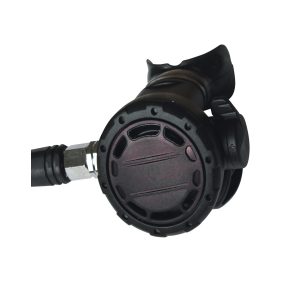
The second stage is the part of the regulator system the diver actually breathes from — it sits in the mouth, senses the slight negative pressure of inhalation, and opens to deliver air at exactly ambient pressure on demand. The Venus NEW is the second stage in the Sopras recreational regulator line, designed for use as a primary regulator or as an octopus alternate air source paired with any of the Jupiter or Genius first stages.
How a Second Stage Works
A second stage regulator connects to an LP port on the first stage via a braided hose and reduces intermediate pressure (8–10 bar above ambient) to exactly ambient pressure — the pressure surrounding the diver at any given depth. It operates on a downstream demand valve principle: a slight negative pressure created by inhalation flexes an exhaust diaphragm, which moves a lever, which opens the valve seat, allowing gas to flow. On exhalation, the diaphragm and valve close, and exhaled gas exits through the one-way exhaust tee beneath the case.
The Venus NEW incorporates this mechanism in a compact, lightweight housing suited to recreational diving. It accepts standard replaceable mouthpieces — silicone, long silicone, mouldable, or dual comfort — allowing the diver to customise the bite and jaw comfort for long dive sessions. For complete regulator systems and technical second stages, the full range is available at SoprasTek.
Primary vs. Octopus Configuration
The Venus NEW is supplied with hose and can be used as a primary second stage (the main regulator the diver breathes from throughout the dive) or as an octopus (alternate air source, connected to a second LP port on the first stage and kept accessible for a buddy’s out-of-air emergency). When used as an octopus, the second stage should be coloured or marked yellow and positioned in the rescue triangle — centre chest, accessible without fumbling. Octopus holders, both standard clip type and magnetic, are available separately to keep it streamlined and immediately deployable.
What to Look For
- Breathing resistance and adjustment: Second stage inhalation effort is affected by IP from the first stage, internal spring tension, and the position of any external adjustment knob. A well-set second stage should breathe with minimal effort at depth without free-flowing at the surface. Any breathing resistance increase over time indicates service is needed.
- Purge button: The purge button manually opens the valve to clear water from the second stage or to perform a regulator recovery. Confirm it operates cleanly and returns completely to the closed position after release — a sticky purge is an early warning sign requiring service.
- Mouthpiece fit and replaceability: Standard second stages accept universal replaceable mouthpieces. If jaw fatigue is an issue on longer dives, a mouldable mouthpiece that heat-forms to individual bite geometry significantly reduces strain.
- Hose routing and swivel: The 360° swivel adapter and swivel attachment to second stage allow the hose to exit in any direction, reducing neck and jaw torque during the dive. This is particularly useful in confined spaces or when switching between positions.
- Compatibility with first stage: Ensure the second stage hose connection (typically 9/16″ male) matches the LP port thread on the first stage. Standard Sopras hoses are compatible across the Genius, Jupiter, and Venus system.
Maintenance and Care
After each dive, rinse the second stage thoroughly in fresh water — with the purge button not pressed and the inlet protected if the first stage has been disconnected. Flush water through the mouthpiece by gently tilting and shaking. Remove and separately rinse the mouthpiece, checking the bite tabs for tears or compression damage; replace if worn. Dry fully with the exhaust tee pointing down to allow any residual water to drain. Do not store with anything compressing the exhaust diaphragm. Periodically inspect the demand diaphragm for stiffness, cracks, or deformation; a damaged diaphragm affects breathing performance immediately and requires replacement. Annual professional servicing covers all internal components, including the valve seat, spring, and diaphragm, and includes a bench test to verify correct cracking effort and delivery volume.
FAQ
Can the Venus NEW be used as both a primary and an octopus?
Yes. The Venus NEW is a standard second stage that can serve as the primary regulator or as an octopus depending on how the diver configures their hose setup. As an octopus it should be positioned accessibly in the rescue triangle and clearly identified — typically with a yellow mouthpiece cover or a yellow hose — so that both the diver and a buddy can locate it instantly in an emergency.
How do I stop my second stage from free-flowing?
Free-flow — continuous uncontrolled air delivery — can be caused by IP set too high from the first stage, a damaged or contaminated valve seat, a stiff or deformed demand diaphragm, or cold water freezing the mechanism open. At the surface, close the cylinder valve and breathe down the regulator to relieve pressure, then have the regulator serviced. Underwater, grip the mouthpiece with the purge button facing down to restrict airflow while ascending. Prevention is through correct IP setting and annual servicing.
How do I change the mouthpiece on the Venus NEW?
Replaceable mouthpieces are secured with a cable tie or retaining clip around the second stage inlet tube. Loosen or cut the existing cable tie, slide off the old mouthpiece, slide on the new one, and secure with a new cable tie tightened snugly but not so tight as to distort the mouthpiece tube. The Comfort dual silicone, mouldable, and silicone long mouthpieces are all compatible with standard second stage inlet diameters.
What is a demand valve and how does it affect breathing?
The demand valve is the mechanism that opens to deliver gas only when the diver inhales — “on demand.” The sensitivity of this valve determines how little effort is needed to trigger airflow. A properly tuned demand valve opens with a very small pressure differential, making breathing feel natural and effortless. A worn or misadjusted valve requires more suction to open, causing noticeable breathing resistance — a sign the regulator needs servicing.
Does the hose length matter for a second stage?
Standard second stage hoses are typically 70–75 cm for the primary regulator. Octopus hoses are conventionally longer — around 100 cm — to allow a buddy to breathe from it while maintaining comfortable distance during a shared air ascent. The Venus NEW is supplied with a standard hose; longer hoses are available separately if an octopus configuration is planned.